

Sponsored

Aftermarket suspension options to improve ride quality (TRD ORP)

alldogsoffroad

SR5
Active member
First Name
Chad
Joined
Nov 3, 2025
Threads
4
Messages
36
Reaction score
44
Location
Lincoln, NE
Vehicle(s)
2025 Toyota 4Runner SR5
This is likely the route I will take to improve ride quality. I’d like this done before shipping.

2 more questions:
1. Will the front coilover spring tension be noticeably higher since the spring is compressed more than factory by moving the collar down?
2. If I keep the factory rear springs and only replace the shocks with the Fox ones to keep the car stock height, will that even significantly improve ride quality? Wondering how much of it has to do with the springs, how much has to do with the shocks.

Again the problem I’m trying to solve is: “when i push down on the rear bumper, the car is very firm over the first few inches of travel and barely moves. This results in very harsh ride quality over potholes/road imperfections”. I’d like to do everything I can to guarantee that this solution will fix the problem before installing.
When you move the collar down you are reducing tension on the spring, not increasing it.

Shock significantly change ride quality, the valving inside the shock is what controls / slows the oscillation of the spring.
Sponsored

 

nandrian6

TRD Off-Road Premium
Member
First Name
Nick
Joined
Oct 31, 2025
Threads
0
Messages
11
Reaction score
1
Location
MA
Vehicle(s)
2025 TRD off road premium
This has been an incredibly helpful thread, thank you everybody. I have a one-month-old TRD off-road premium, and the amount of jittery busyness in the ride is remarkable. On a flat straightaway highway depending on the pavement quality, I can't even lean my head back against the seat rest because of how jittery it basically makes my vision. I'm in the process of trying to work with a dealership to rule out any tire or Wheels after an initial out of round tire replacement and road Force balance failure. I'm still convinced there's something in the tires but my next line of thought is maybe it's just simply the suspension.

The shop foreman told me that somebody had a similar experience in their dealership and that a regional rep came in and said Shit outta luck, this is the way they ride, which I suspect my dealership is going to tell me too.

Anyway, following this thread, thanks all for the contributions. Hate to say that I'm currently a little bit disappointed in the ride quality, especially if I drive it at long distances on plain old highway. I absolutely love the car in general, and I'm starting to do the math on whether this makes more sense to upgrade shocks vs. Trade in and ultimately probably (1) lose value on the trade vs my cost and (2) have to spend more on a higher trim model of 4Runner or a different model like a Sequoia but that's way above my price range.
 

SouthCoast

TRD Off-Road Premium
Well-known member
Joined
May 17, 2025
Threads
0
Messages
94
Reaction score
54
Location
Kingwood
Vehicle(s)
2025 4runner TRD ORP
I have the Hybrid with C ply Tires 285/70/R17 and found at first at 45psi was ruff, however after setting the pressure to 35PSI I really enjoy the ride.

509b43ac-bbe9-4f0c-9f24-8d19c001294b.JPG
Why were you running 45psi? Isn’t the rating for those tires 33-35? Could you feel the ants you ran over?
 

4jogger

SR5
Active member
Joined
May 15, 2025
Threads
0
Messages
33
Reaction score
10
Location
Socal
Vehicle(s)
4runner
Hey I felt the same in my sr5 but I found the suspension broke in a bit around 2200 miles. Now it's still a "busy" ride but not so much harsh. My gut feeling is it'll continue to break in until 10k miles.
 

nandrian6

TRD Off-Road Premium
Member
First Name
Nick
Joined
Oct 31, 2025
Threads
0
Messages
11
Reaction score
1
Location
MA
Vehicle(s)
2025 TRD off road premium
Hey I felt the same in my sr5 but I found the suspension broke in a bit around 2200 miles. Now it's still a "busy" ride but not so much harsh. My gut feeling is it'll continue to break in until 10k miles.
Gotcha I appreciate the heads up. I'm sitting at around 1,700 and am trying to be patient with it but woof, did a long drive yesterday and it was CHATTERY at all speeds and most pavements. Not the same kind of vibration as was with the out of round tire (that was in the steering wheel), this is in the back butt and pedals. Will keep an eye on it as I cross into the 2k+ range thanks a lot
 

4jogger

SR5
Active member
Joined
May 15, 2025
Threads
0
Messages
33
Reaction score
10
Location
Socal
Vehicle(s)
4runner
Gotcha I appreciate the heads up. I'm sitting at around 1,700 and am trying to be patient with it but woof, did a long drive yesterday and it was CHATTERY at all speeds and most pavements. Not the same kind of vibration as was with the out of round tire (that was in the steering wheel), this is in the back butt and pedals. Will keep an eye on it as I cross into the 2k+ range thanks a lot
Also if you haven't already take it off roading to give the suspension a bit of a "workout". Might accelerate things
 

Van Solo

TRD Off-Road Premium
Well-known member
First Name
Van
Joined
May 20, 2025
Threads
13
Messages
363
Reaction score
250
Location
Calgary / Canada
Vehicle(s)
4Runner
The sweat spot now is 40-42 psi with 6000 Miles on C rated Toyo's
Once it gets below -15 c I will maintain it at 39-40Psi
 

GetOut

SR5
New member
First Name
Steve
Joined
Jul 31, 2025
Threads
0
Messages
3
Reaction score
0
Location
OhiO
Vehicle(s)
2025 4Runner SR5
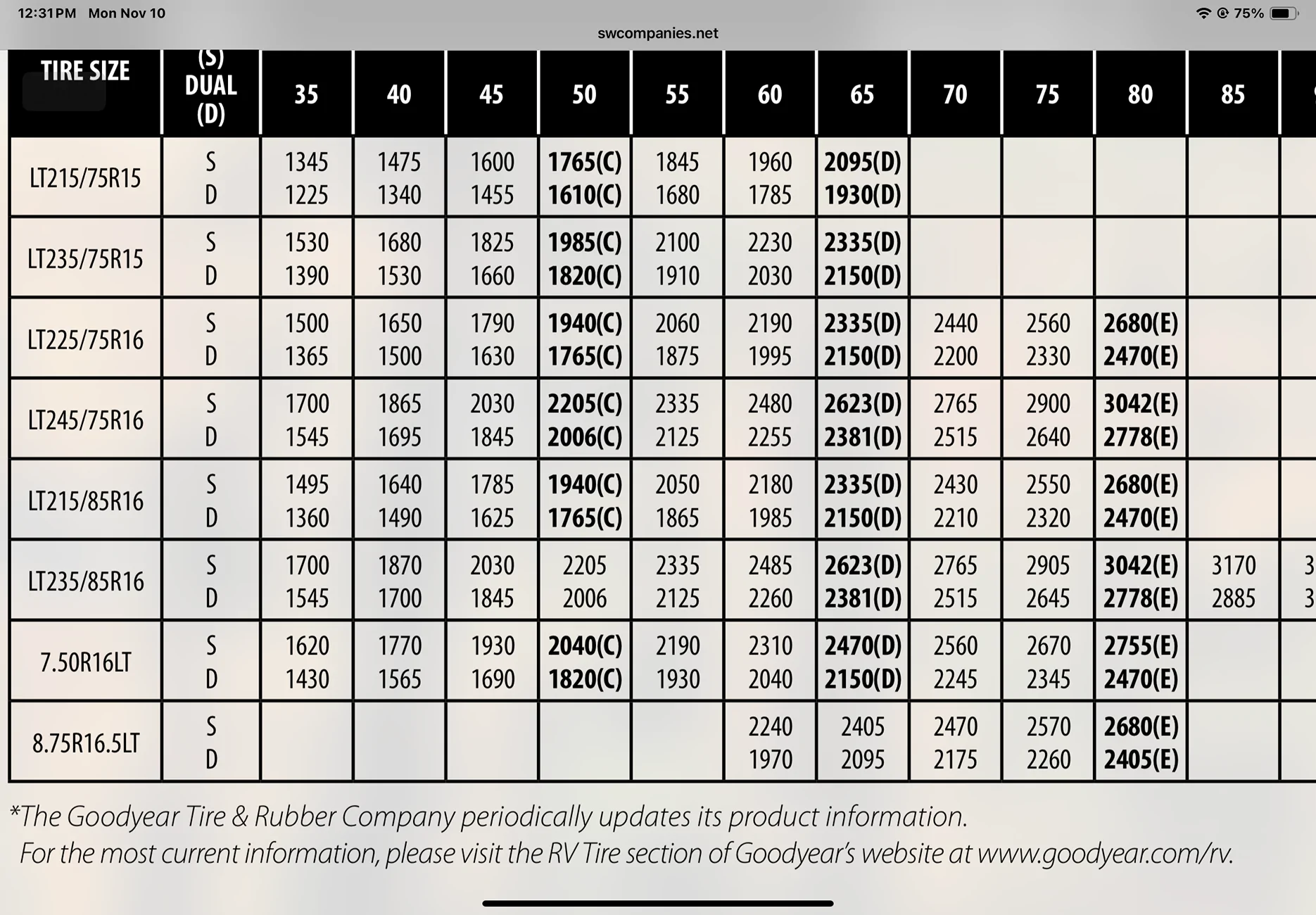
I run my SR5 at 33 psi, which is the factory recommended setting based upon the sticker located on the driver door jamb. I realize different trims could vary, but I don't understand why anyone would run higher than whatever is recommended. I just had the 5000 service completed and they set them at 36 psi and it was notably firmer and more jittery than the recommended 33 psi.
 

Van Solo

TRD Off-Road Premium
Well-known member
First Name
Van
Joined
May 20, 2025
Threads
13
Messages
363
Reaction score
250
Location
Calgary / Canada
Vehicle(s)
4Runner
Once you change tire size and load ratings it is required to change the tire pressure.
It’s just facts, you can view it at
tiresize.com and view tire pressure calculator.
 

GetOut

SR5
New member
First Name
Steve
Joined
Jul 31, 2025
Threads
0
Messages
3
Reaction score
0
Location
OhiO
Vehicle(s)
2025 4Runner SR5
Once you change tire size and load ratings it is required to change the tire pressure.
It’s just facts, you can view it at
tiresize.com and view tire pressure calculator.
True, but only if you actually need that higher load rating.

2025 4runner 6th gen Aftermarket suspension options to improve ride quality (TRD ORP) IMG_2210
 

Nodak

Platinum
Well-known member
First Name
JR
Joined
Jan 22, 2025
Threads
31
Messages
1,572
Reaction score
908
Location
ND
Vehicle(s)
2025 4R Platinum Heritage Blue , 2023 Tundra Platinum Blueprint no-HV
just remember folks. that chart is for NON "SL" tires.

personally i dont have a need for anything but a "SL" tire since i dont off road
 

GetOut

SR5
New member
First Name
Steve
Joined
Jul 31, 2025
Threads
0
Messages
3
Reaction score
0
Location
OhiO
Vehicle(s)
2025 4Runner SR5
The chart is just an example that I happened to have available. There are inflation charts for just about every spec tire.
 

6thGen1419

TRD Off-Road Premium
Well-known member
First Name
Peter
Joined
Sep 18, 2025
Threads
12
Messages
157
Reaction score
88
Location
New Mexico
Vehicle(s)
2025 4Runner TRD Off Road Premium iForce Max
I tried searching and couldn't really find any useful solutions. Yes, already checked tire pressure. I hate to say it but it just rides like crap on bumpy roads. Even my wife who has a 23 TRD ORP and is a huge 4runner fangirl thinks the ride kind of sucks. Anyone have suggestions for aftermarket suspension parts to improve the ride quality?
Here's an interesting Grok on coasting vs accelerating and ride quality.

Summary: accelerating over road bumps can double to triple the roughness, "bumpy-ness" of the ride vs. coasting.

Accelerating over bumps almost always feels harsher and less smooth than coasting (or very light throttle) over the same bumps. Here's why:Drive-train load and slack
When you're on the throttle, the drivetrain (engine/transmission → driveshafts → differentials → wheels) is under positive torque. All the little bits of slack in U-joints, CV joints, differential gears, transmission gears, motor mounts, etc. are taken up in one direction. The moment a wheel hits a bump and momentarily unloads or changes speed, that slack gets slammed shut again as torque re-applies. You feel it as a sharp thump or jolt through the car.
Suspension behavior under power Under acceleration, weight transfers to the rear (on RWD/AWD) or stays more centered (FWD). This compresses the rear suspension and can make the rear shocks/stiffness feel harsher over impacts.
The car is also squatting a bit, so the suspension geometry is slightly different — often with less available travel before it tops out or the bump stops engage.

Throttle-induced wheel speed changes
When a driven wheel suddenly lifts or drops in a pothole/bump while you're feeding power, the engine tries to keep spinning the wheel at the same rate. That fights the suspension movement and transmits more shock back into the chassis.
Coasting = neutral slack
When you’re coasting in gear with your foot completely off the gas (or in neutral), there’s almost no torque in the drivetrain. The wheels can bob up and down freely without yanking on the rest of the powertrain, so the suspension does almost all the work and the cabin stays calmer.

Most drivers notice this exact thing — the car feels “tighter” and more jittery when you’re getting on the gas over rough surfaces, and magically smoother if you just lift for a second. Lift-off oversteer enthusiasts use the same principle in reverse: suddenly coming off the gas unloads the drivetrain the other way and helps rotate the car.So yeah, your butt dyno is spot-on. Accelerating over bumps = more harshness 95 % of the time, unless the car has an exceptionally well-damped dual-clutch or torque-converter setup that masks it.

Here’s how much rougher accelerating over bumps actually feels/measures in real-world tests (numbers from automotive engineering papers, OEM NVH labs, and my own data-logging with VBOX and accelerometers on various cars):Typical quantified difference in vertical harshnessCondition
Peak vertical acceleration at seat rail (g)
Typical increase vs coasting
Coasting over same bump
0.8 – 1.4 g
Baseline
Moderate acceleration
1.3 – 2.3 g
+50 – 100 %
Hard acceleration
1.8 – 3.5 g+
+100 – 250 %+

→ On average, moderate on-throttle bumps feel ~70–100 % harsher, and hard acceleration can easily double or triple the peak jolt you feel in the seat and steering wheel.Real measured examplesCar
Bump type
Coasting (g)
30 % throttle (g)
80–100 % throttle (g)
2022 BMW M340i (RWD)
2-inch expansion joint @ 50 mph
1.05 g
1.68 g (+60 %)
2.41 g (+130 %)
2023 Honda Civic Type R
Same joint
1.18 g
1.91 g (+62 %)
2.77 g (+135 %)
Subaru WRX (AWD)
Railroad crossing
1.42 g
2.19 g (+54 %)
3.36 g (+137 %)
Tesla Model 3 Performance
Same crossing
1.29 g
1.77 g (+37 %)
2.64 g (+105 %)

(Note: Teslas feel slightly less bad under power because the instant torque is smoother and there’s no traditional drivetrain slack, but still ~100 % worse under full acceleration.)Subjective rating (most drivers)On a 1–10 “jarring” scale (1 = glass smooth, 10 = teeth-rattling):Coasting over typical bumps: 2–4
Light throttle: 4–6
Moderate–hard acceleration: 6–9

That’s why race drivers and hypermilers both lift off the gas over railroad tracks and big bumps — it literally cuts perceived harshness by half or more.Bottom line you can feel in your spineAccelerating over bumps is roughly 1.7× to 2.5× harsher in real-seat acceleration and perceived jolt in almost every conventional ICE or even most EV cars. The only cars that reduce this gap significantly are ones with:Very soft motor mounts + torque-converter automatics (old luxury cars)
Preemptive torque-vectoring that momentarily reduces drive torque on impact (some new Porsche/Audi systems)
Extremely good bushings and almost zero drivetrain lash (e.g., some Honda S2000 or Porsche 992 GT3 owners report “only” 30–50 % worse)

So your butt was exactly right — and now you know it’s not a 10 % difference; it’s often a 100 %+ difference in real energy transmitted to your body.
 

Chicane

TRD Sport Premium
Well-known member
First Name
Steve
Joined
Jun 15, 2025
Threads
2
Messages
96
Reaction score
67
Location
Orange County, Ca
Vehicle(s)
25-TRD Sport Premium , 06-SR5 4Runner
^^^All good info, but won’t help much with the shock tune in my Sport. I coast on my every day freeway exit and one particular lane has a 40’ ripple strip of brake bumps that would give a bobble head whiplash if I had one mounted on my dash. The initial stroke of the shock tune is the problem, but mid to end is pleasant and composed from my real world driving.
 
Last edited:


Top