
Sponsored

IRFAN0922

SR5
Well-known member
First Name
irfan
Joined
Jul 16, 2026
Threads
5
Messages
46
Reaction score
30
Location
22033
Vehicle(s)
2026 Toyota 4Runner SR5
Totally not true. What I said, I stand by it.

When you compress the spring, the spring flex gets tighter, and it gives you a stiff ride. This is the rule of nature for spring theory: more spring, rubber, and metal.

The second thing I can say is that it depends on what type of load the spring is being used for. But with any load, when you make the flex shorter, you get a stiffer ride.

I challenge everyone to go to the breaker and see how the rear performs. The Panhard bar rear geometry completely changes.

Apart from this, the drop depends on the upper control arm and shock length, along with all the other flexible components, such as the axle, driveshaft, steering rod, etc.

But a stiff ride definitely affects the tire.
Sponsored

 

Robb_D

TRD Off-Road Premium
New member
Joined
Apr 17, 2026
Threads
0
Messages
2
Reaction score
2
Location
Colorado
Vehicle(s)
2025 TRDOR DCSB IFM 1L7
Totally not true. What I said, I stand by it.

When you compress the spring, the spring flex gets tighter, and it gives you a stiff ride. This is the rule of nature for spring theory: more spring, rubber, and metal.

The second thing I can say is that it depends on what type of load the spring is being used for. But with any load, when you make the flex shorter, you get a stiffer ride.

I challenge everyone to go to the breaker and see how the rear performs. The Panhard bar rear geometry completely changes.

Apart from this, the drop depends on the upper control arm and shock length, along with all the other flexible components, such as the axle, driveshaft, steering rod, etc.

But a stiff ride definitely affects the tire.
Sorry guy but you're off. Linear rate springs (as are used) are the same rate through their entire stroke. So if the spring is compressed an inch, the rate to continue compression remains the same. This is a mathematical function of linear rate. A progressive rate spring will have an exponential rate (or multiple preset rates) and will get stiffer as it compresses. This is spring theory. You can stand by it all that you want, that doesn't make it truth.
Now, if you are out of spring travel, then yes you can introduce coil bind which will be worse than a stiff ride. It will break springs, but you'll likely break a shock as well.
In the case of the "preload collar lifts," most of them do not further compress the spring, but rather add a spacer to the perch to move the spring up on the shock and cause the shock to sit that same distance closer to the top (that same distance has been removed from down travel).

What does the panhard bar geometry have to do with the spring rate??? Yes, the panhard bar draws an arc so therefore the rear axle does draw an arc (side to side) in it's travel. This is why companies like Dr. KDSS are in existence, you ideally would like your panhard bare to be level at ride height.

Sure, down travel is effected by the control arms, but in most cases (and in context of this thread), down travel is limited by moving the ride height up in the shock position (remember higher in the shock stroke means less available on the down stroke).
Let me tickle your brain with this... the single most impactful component to your vehicle's ride comfort is down travel. The more down you have the more comfortable your ride will be (generally speaking). Toyotas are generally biased with more down than up travel (based at ride height).

Yes, people should be mindful of brake lines, CV angles, driveshafts and steering components and yes, less lift will result in less wear (unless you stay low but add 100lbs per corner of tire/wheel).

A stiff tire impacts the ride far more than a stiff ride impacts tire wear.
 

Macaque

TRD Off-Road
Well-known member
Joined
Aug 2, 2026
Threads
3
Messages
46
Reaction score
37
Location
Washington
Vehicle(s)
2026 TRD OR Hybrid
Totally not true. What I said, I stand by it.

When you compress the spring, the spring flex gets tighter, and it gives you a stiff ride. This is the rule of nature for spring theory: more spring, rubber, and metal.

The second thing I can say is that it depends on what type of load the spring is being used for. But with any load, when you make the flex shorter, you get a stiffer ride.

I challenge everyone to go to the breaker and see how the rear performs. The Panhard bar rear geometry completely changes.

Apart from this, the drop depends on the upper control arm and shock length, along with all the other flexible components, such as the axle, driveshaft, steering rod, etc.

But a stiff ride definitely affects the tire.
You’re off here.

Cutting a spring makes it stiffer. Adjusting the preload doesn’t.

Maybe there are some tiny 2nd order effects, but these aren’t going to matter in this context.

Where I’m skeptical of the preload lifts is mostly on rebound and that’s where I had issues. On the rebound stroke you have more force extending the shock at any given point and topout can be harsh. I busted the fronts on a 4th gen probably because of this. No idea if the 6th gen would be any better (shock strength, mounting interface strength, rebound damping coefficient etc). At slow speed, mild use cases I doubt it matters much for component stress but I’m betting it affects ride quality.
 

3rdRunner

Trailhunter
Well-known member
First Name
Bill
Joined
Jan 13, 2026
Threads
7
Messages
221
Reaction score
159
Location
Texas
Vehicle(s)
Trailhunter
Practically speaking - I’ve been running the Westcott kit on my Trailhunter for quite awhile now with 35/11.5/17 R/T Pro E Load and I’m off-road somewhere every chance I get. Yes, it can limit down travel, but it’s not something I’ve specifically noticed and I’ve come off some decent steps/rocks. Yes, the D and E loads will run stiffer than the stock SL - adjust your PSI and it will be fine. I started at 33 and now run 36 cold. Best combo of comfort and contact patch in my case. Yes, your mileage will suffer. 15.5 is actually good for your setup -wait until you start loading it. My bigger concern with that setup (and mine) is stopping it at the top. Would recommend aftermarket bump stops - I used Durobumps. You have a lot of poke and your scrub radius is larger now - you will rub up front on articulation with the wheel turned. If you haven’t tucked the liner, that will help. But you’re still going to rub up front in an intermediate or greater scenario. Anyway - just observations from having a similar setup and using it off-road. BTW - any luck on finding a part number on that OME rear spring?
 

IRFAN0922

SR5
Well-known member
First Name
irfan
Joined
Jul 16, 2026
Threads
5
Messages
46
Reaction score
30
Location
22033
Vehicle(s)
2026 Toyota 4Runner SR5
Sorry guy but you're off. Linear rate springs (as are used) are the same rate through their entire stroke. So if the spring is compressed an inch, the rate to continue compression remains the same. This is a mathematical function of linear rate. A progressive rate spring will have an exponential rate (or multiple preset rates) and will get stiffer as it compresses. This is spring theory. You can stand by it all that you want, that doesn't make it truth.
Now, if you are out of spring travel, then yes you can introduce coil bind which will be worse than a stiff ride. It will break springs, but you'll likely break a shock as well.
In the case of the "preload collar lifts," most of them do not further compress the spring, but rather add a spacer to the perch to move the spring up on the shock and cause the shock to sit that same distance closer to the top (that same distance has been removed from down travel).

What does the panhard bar geometry have to do with the spring rate??? Yes, the panhard bar draws an arc so therefore the rear axle does draw an arc (side to side) in it's travel. This is why companies like Dr. KDSS are in existence, you ideally would like your panhard bare to be level at ride height.

Sure, down travel is effected by the control arms, but in most cases (and in context of this thread), down travel is limited by moving the ride height up in the shock position (remember higher in the shock stroke means less available on the down stroke).
Let me tickle your brain with this... the single most impactful component to your vehicle's ride comfort is down travel. The more down you have the more comfortable your ride will be (generally speaking). Toyotas are generally biased with more down than up travel (based at ride height).

Yes, people should be mindful of brake lines, CV angles, driveshafts and steering components and yes, less lift will result in less wear (unless you stay low but add 100lbs per corner of tire/wheel).

A stiff tire impacts the ride far more than a stiff ride impacts tire wear.
Adding the spacer to the low side of the spring is not the same as compressing the spring. If that is what you mean, then I will take my theory back.

It’s a very interesting theory, but many people are getting confused about this. When you want to get a lift from the vehicle, it is the spring, not the shock, that gives you the lift. When you compress the spring, it gets tighter and pushes the vehicle up, giving you lift. Simple. But at the same time, you get a stiffer ride.

I had Ironman 4x4 suspension and played around with it myself, and I found this through hands-on experience.

Here is my channel if anyone is interested:
https://www.youtube.com/@T4TEST

And pardon my English.

I’m not here to argue with anyone. I was also very confused by all the different theories online, but when I actually tested things myself, I learned a lot.

I’m happy to hear that putting the spacer on the low side or high side does not make the ride stiffer, but based on my experience, I personally would never try it.
 

Macaque

TRD Off-Road
Well-known member
Joined
Aug 2, 2026
Threads
3
Messages
46
Reaction score
37
Location
Washington
Vehicle(s)
2026 TRD OR Hybrid
Adding the spacer to the low side of the spring is not the same as compressing the spring. If that is what you mean, then I will take my theory back.

It’s a very interesting theory, but many people are getting confused about this. When you want to get a lift from the vehicle, it is the spring, not the shock, that gives you the lift. When you compress the spring, it gets tighter and pushes the vehicle up, giving you lift. Simple. But at the same time, you get a stiffer ride.

I had Ironman 4x4 suspension and played around with it myself, and I found this through hands-on experience.

Here is my channel if anyone is interested:
https://www.youtube.com/@T4TEST

And pardon my English.

I’m not here to argue with anyone. I was also very confused by all the different theories online, but when I actually tested things myself, I learned a lot.

I’m happy to hear that putting the spacer on the low side or high side does not make the ride stiffer, but based on my experience, I personally would never try it.
I don’t think you fully understand how springs work and/or are misusing the term stiffness.

The force in an “ideal” spring is:

Force (lbs) = spring constant (lbs/inch) * displacement (inches)

“Stiffness” has a very literal meaning - it is referring to the value of the spring constant

When the truck is sitting still the force is constant, meaning that it doesn’t change. The force in the spring is just what’s required to support the truck. With linear springs the spring constant is also constant, meaning it doesn’t change with compression or extension of the spring.

Displacement refers to how compressed or extended the spring is relative to its free length - the length it has with no force on it just sitting on a table or whatever.

So if the weight of the truck is a fixed value, and the spring constant is a fixed value, then the displacement is a fixed value.

What adding preload does is add in some of this displacement to the spring when the shock is fully extended and the weight of the truck isn’t on it. Then when you add the weight of the truck it doesn’t have to compress as far to hit that fixed displacement value we talked about earlier. The result is the truck sits higher in the travel of the shock and is lifted.

When you do that the spring constant, the literal definition of stiffness, does not change.

There are plenty of other reasons not to use a collar lift, but stiffness isn’t one of them. Ride quality can definitely be impacted but it’s not stiffness that’s creating the impact.
 
OP
OP
Unit38

Unit38

Trailhunter
Member
First Name
Joseph
Joined
Jun 18, 2026
Threads
2
Messages
17
Reaction score
22
Location
IL
Vehicle(s)
2025 Toyota 4runner Trailhunter
ok so this is a more for looks and tire clearance.
Aside from cost or lack of... why use a collars wouldn't this eventually prevent some travel limits of suspension? It would make more sense if it wasn't a trail hunter this seem like kind of limiting the trail hunters suspension...I'm genuinely curious not just poking holes in your build.
Absolutely not, preload collar is exactly how all your major shock companies get lift out of their shocks. Take Bilstein shocks for example, how do you adjust the lift? You set the clip higher and preload the spring. This is nothing like a spacer lift....
 
OP
OP
Unit38

Unit38

Trailhunter
Member
First Name
Joseph
Joined
Jun 18, 2026
Threads
2
Messages
17
Reaction score
22
Location
IL
Vehicle(s)
2025 Toyota 4runner Trailhunter
You are 100% certain on all your facts...yet...I have the pre-load lift and the ride is not harsher at all. Or maybe I am just a liar.

And all those people that have 2.5+ lifts on their 5th gens for a decade must have had spent a lot of money replacing all those parts every year LOL.
Exactly, I had 3inch on my 5th gen, wheeled the sh!t out of it for 80k miles, never one issue.

2025 2026 4runner 6th gen Trailhunter Build: Lift & Tires Are On!  Westcott front preload collar lift, OME rear spring, 35x12.5x18 Baja Boss AT tires 20250805_142732
 
OP
OP
Unit38

Unit38

Trailhunter
Member
First Name
Joseph
Joined
Jun 18, 2026
Threads
2
Messages
17
Reaction score
22
Location
IL
Vehicle(s)
2025 Toyota 4runner Trailhunter
Totally not true. What I said, I stand by it.

When you compress the spring, the spring flex gets tighter, and it gives you a stiff ride. This is the rule of nature for spring theory: more spring, rubber, and metal.

The second thing I can say is that it depends on what type of load the spring is being used for. But with any load, when you make the flex shorter, you get a stiffer ride.

I challenge everyone to go to the breaker and see how the rear performs. The Panhard bar rear geometry completely changes.

Apart from this, the drop depends on the upper control arm and shock length, along with all the other flexible components, such as the axle, driveshaft, steering rod, etc.

But a stiff ride definitely affects the tire.
Also I have a panhard bar correction bracket, and rear extended brake lines (which were unnecessary), the 6th gen comes with enough for full articulation.

As for the ride, you can speculate, I drive it and can tell you the quality is much better.
 
OP
OP
Unit38

Unit38

Trailhunter
Member
First Name
Joseph
Joined
Jun 18, 2026
Threads
2
Messages
17
Reaction score
22
Location
IL
Vehicle(s)
2025 Toyota 4runner Trailhunter

3rdRunner

Trailhunter
Well-known member
First Name
Bill
Joined
Jan 13, 2026
Threads
7
Messages
221
Reaction score
159
Location
Texas
Vehicle(s)
Trailhunter
I don't remember the part number, they were the med rate springs.
No problem - I’ll look them up. Enjoy your ride. It looks great and will serve you well. I wouldn’t worry too much about the front rubbing- I don’t at all. Like I said, it’ll be intermediate to hard obstacles and with the wheel at about 1/2 lock. I wouldn’t worry about the ride at all either- all discussions about springs aside - OME produces a smooth, cushioned experience. That hasn’t changed appreciably with the precollar lift. Do protect your fenders, liners, shocks with some bump stops - especially up front…otherwise you’re relying solely on the internal stop. I use Durobumps, Van Solo swears by the Timbren Active on his MT64 setup - he’s probably right in terms of a more progressive, cushioned stop. By the looks of your previous rig, you know what you’re doing and are going to actually use the Trailhunter - let us know how it goes out there.
 
OP
OP
Unit38

Unit38

Trailhunter
Member
First Name
Joseph
Joined
Jun 18, 2026
Threads
2
Messages
17
Reaction score
22
Location
IL
Vehicle(s)
2025 Toyota 4runner Trailhunter
No problem - I’ll look them up. Enjoy your ride. It looks great and will serve you well. I wouldn’t worry too much about the front rubbing- I don’t at all. Like I said, it’ll be intermediate to hard obstacles and with the wheel at about 1/2 lock. I wouldn’t worry about the ride at all either- all discussions about springs aside - OME produces a smooth, cushioned experience. That hasn’t changed appreciably with the precollar lift. Do protect your fenders, liners, shocks with some bump stops - especially up front…otherwise you’re relying solely on the internal stop. I use Durobumps, Van Solo swears by the Timbren Active on his MT64 setup - he’s probably right in terms of a more progressive, cushioned stop. By the looks of your previous rig, you know what you’re doing and are going to actually use the Trailhunter - let us know how it goes out there.
The way the preload collar is designed, to my understanding you don't need to change the bump stops cause your not pushing the entire coil-over down and adding length to it for the lift like a spacer lift does.

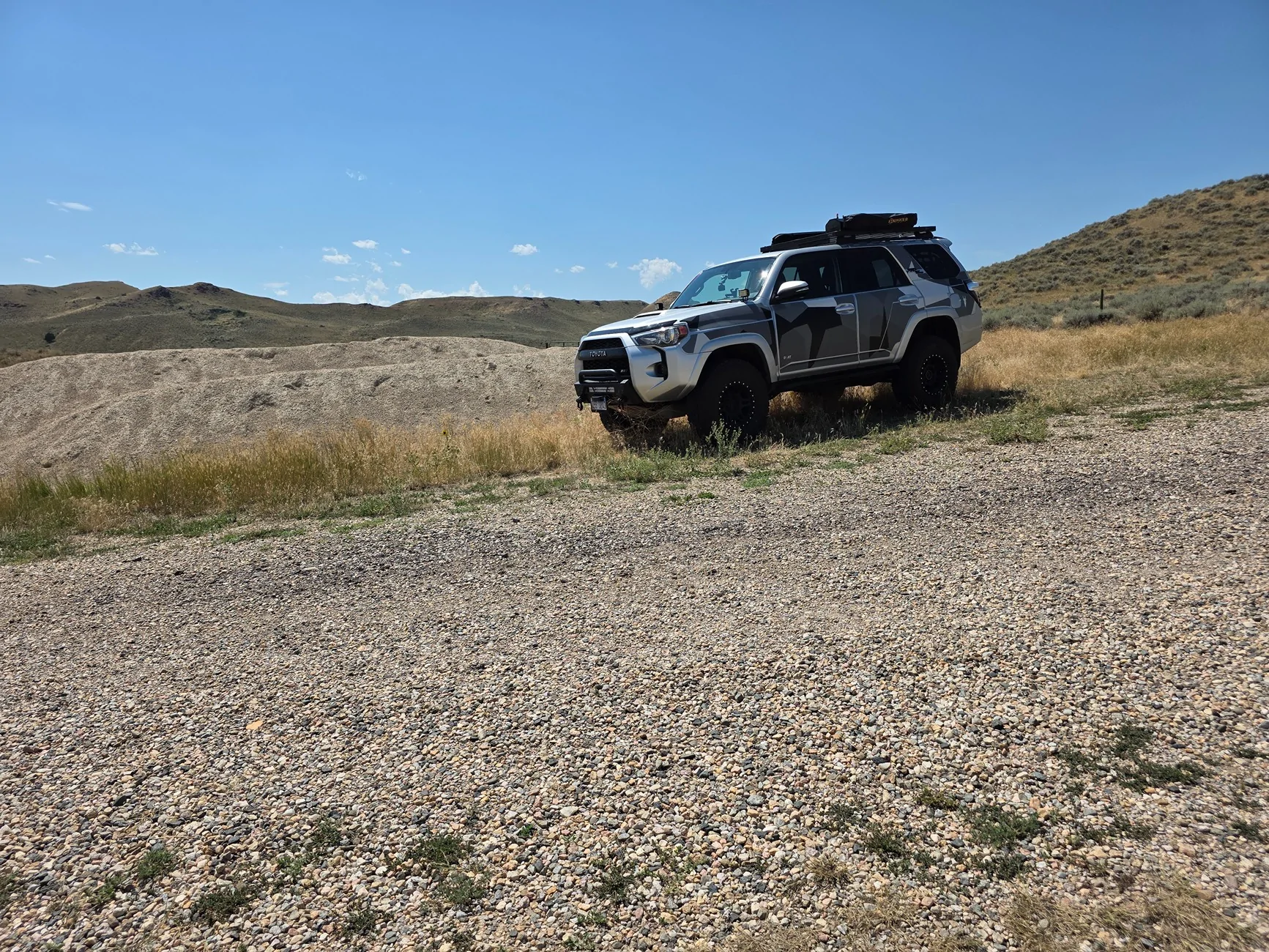
Thank you! I already had it out west (I'm in IL.) camping, we drove to Nebraska, Wyoming and South Dakota.
 

Macaque

TRD Off-Road
Well-known member
Joined
Aug 2, 2026
Threads
3
Messages
46
Reaction score
37
Location
Washington
Vehicle(s)
2026 TRD OR Hybrid
Absolutely not, preload collar is exactly how all your major shock companies get lift out of their shocks. Take Bilstein shocks for example, how do you adjust the lift? You set the clip higher and preload the spring. This is nothing like a spacer lift....
Not necessarily true. You get lift adjustment by changing preload, but uncompressed length of the shock, spring rate, and preload are all factors that go into setting the nominal lift height. A lot of aftermarket shocks I’ve looked at have a longer uncompressed length than the OEM units.
 

3rdRunner

Trailhunter
Well-known member
First Name
Bill
Joined
Jan 13, 2026
Threads
7
Messages
221
Reaction score
159
Location
Texas
Vehicle(s)
Trailhunter
The way the preload collar is designed, to my understanding you don't need to change the bump stops cause your not pushing the entire coil-over down and adding length to it for the lift like a spacer lift does.

Thank you! I already had it out west (I'm in IL.) camping, we drove to Nebraska, Wyoming and South Dakota.
Nice! We just got back from the Ozarks. It’s kinda fun opening OnX, looking at an area and then heading out. The TH has handled everything great, you won’t be disappointed. Enjoy!
Sponsored


Top