
This also isn’t making sense. My limited has a sticker for 27 lbs or something like that, and the only PIO is rubber floor mats!They add a yellow "adjustment" sticker for the per-vehicle port/dealer installed options.
Sponsored
This also isn’t making sense. My limited has a sticker for 27 lbs or something like that, and the only PIO is rubber floor mats!They add a yellow "adjustment" sticker for the per-vehicle port/dealer installed options.
3 row doesnt have the hybrid battery packMy gas limited 4wd also says 895. It was just delivered to the dealership on the 11th. How do all of these different trims have the same payload capacity, given different curb weights?
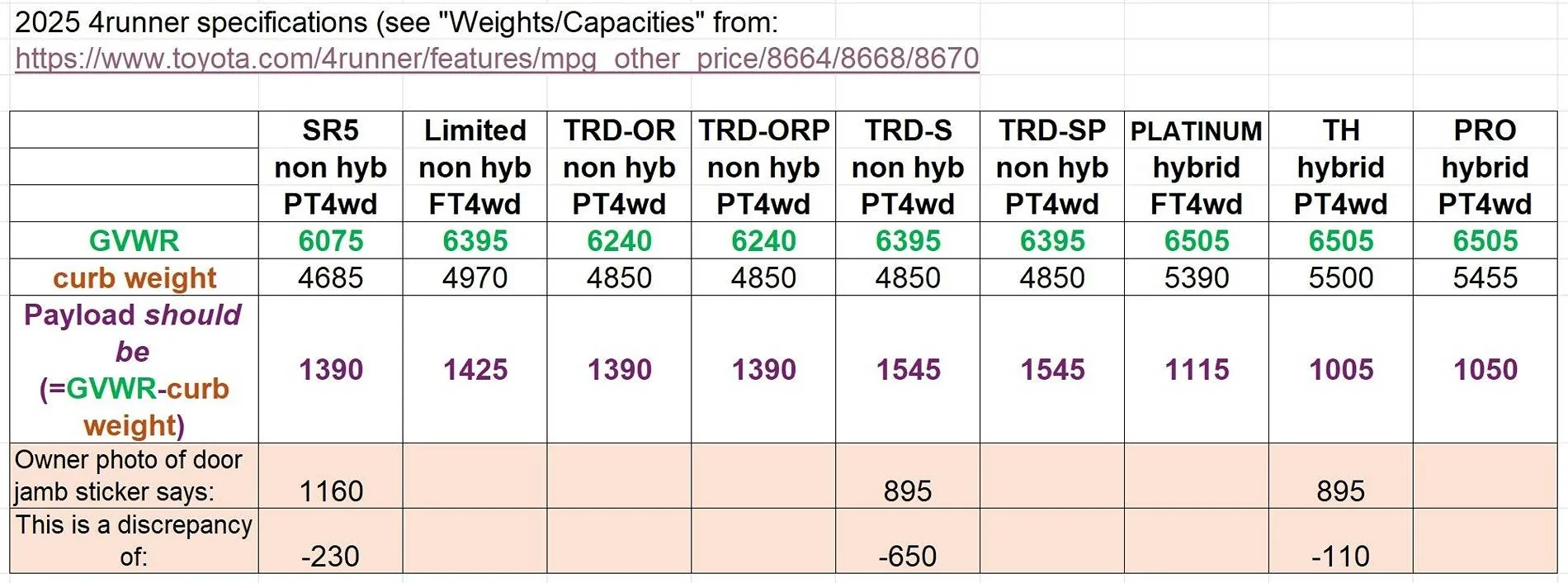
strangely the manual says that all 2-row models are 895 and all 3-row models are something like 1160. Makes no sense to me!

I'm ORP, no hybrid, 2 row seats, 895 payload.3 row doesnt have the hybrid battery pack
most 2 rows are hybrids and the ones without the hybrid should have a higher payload i am guessing
I don’t think most 2-rows are hybrids. Mine certainly isn’t, and the payload should be a lot more than 895 lbs based on the curb weight and the GVWR!3 row doesnt have the hybrid battery pack
most 2 rows are hybrids and the ones without the hybrid should have a higher payload i am guessing
Thanks, and agreed. Hopefully they answer, but I'm also not optimistic that we'll get anything useful.I don’t think most 2-rows are hybrids. Mine certainly isn’t, and the payload should be a lot more than 895 lbs based on the curb weight and the GVWR!
I sent a request to Toyota customer care to see if they can clarify the payload specs. Not holding my breath, but that would be nice.
The question here is, if you exceed the 895 but stay well under GVWR-Curb, can they use that against you if something were to go wrong.
Thank you for reaching out regarding your 2025 Toyota 4Runner and your question about the sticker on your vehicle related to payload capacity. We appreciate the opportunity to assist you further.
Based on our research using sources 2025 Toyota 4Runner Specifications | Toyota.comand 2025 Toyota 4Runner - Toyota USA Newsroom your vehicle’s curb weight is 4,970 lbs., and the Gross Vehicle Weight Rating (GVWR) is 6,395 lbs.
The 895 lbs. figure you mentioned appears in the Owners Manual as the vehicle capacity weight, which refers to the combined weight of occupants and luggage. It’s important to understand that vehicle capacity weight and payload are related but not the same. Payload includes additional factors and represents the total weight your vehicle can safely carry beyond its curb weight, including passengers, cargo, accessories, and tongue weight (if applicable).
Since these terms involve different measurements and calculations, we recommend visiting your local Toyota dealership for a more detailed explanation and personalized assistance. They can also clarify the exact meaning of the sticker on your door.
We apologize for not being able to fully resolve your concern here. Please know your comments have been documented at Toyota National Headquarters under reference number
Are you serious? wow, that's interesting. My 2025 SR5 4Runner with PT4WD illustrates 1160/1165 lbs on the door jam..i'm going to take a second look...i might be seeing things..lolFor what it’s worth, I picked up my 2026 SR5 4x4 last week, and similarly have the 895lbs payload in the door jam sticker, and Gvwr 6075lbs. I went and weighed it: 7/8th tank of gas, dealer installed cross bars, all weather mats, plus a toddler car seat, and a moving blanket in the trunk: weight was 4760lbs. So a payload of 1315lbs after the above additions - pretty consistent with the Toyota reported curb weight, making the door jam sticker way off.
It was a shock when I picked it up - I had got it tow a camper and realised if the door jam was accurate I wouldn’t be able to bring my wife or kid!Are you serious? wow, that's interesting. My 2025 SR5 4Runner with PT4WD illustrates 1160/1165 lbs on the door jam..i'm going to take a second look...i might be seeing things..lol
Do you have a 3rd row of seats? Seems like they are doing one weight for all two-row trims, and one slightly higher weight for all three-row trims. Actual weight, add ons, etc don’t influence the sticker. They do add an additional adjustment sticker. My theory is it’s what they tested or crash tested so that’s what they put.Are you serious? wow, that's interesting. My 2025 SR5 4Runner with PT4WD illustrates 1160/1165 lbs on the door jam..i'm going to take a second look...i might be seeing things..lol
I wondered if they had just based it off the payload of the heaviest spec for the 2 and 3 row versions respectively. ie the trail hunter only comes in 2 row, so all 2 rows got a door jam sticker for that payload.Do you have a 3rd row of seats? Seems like they are doing one weight for all two-row trims, and one slightly higher weight for all three-row trims. Actual weight, add ons, etc don’t influence the sticker. They do add an additional adjustment sticker. My theory is it’s what they tested or crash tested so that’s what they put.
Yes. I do have a third row..Do you have a 3rd row of seats? Seems like they are doing one weight for all two-row trims, and one slightly higher weight for all three-row trims. Actual weight, add ons, etc don’t influence the sticker. They do add an additional adjustment sticker. My theory is it’s what they tested or crash tested so that’s what they put.
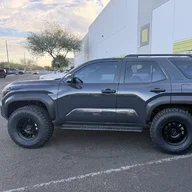
2026 TRD ORP with 5x 35" tires/wheels and a hitch spare tire carrier and a full tank of gas weighed today, 5420 lbs.