
Sponsored
OP
OP
CAMTuning

CAMTuning

TRD Off-Road
Well-known member
Site Sponsor
First Name
Cam
Joined
Nov 14, 2025
Threads
10
Messages
123
Reaction score
193
Location
NM
Vehicle(s)
2025 Tacoma TRD OffRoad
I can appreciate your POV & perspective on this topic. As I said in a previous post, I'm not a gearhead or well-versed in high performance automotive applications. With that said, I'm no meathead either & this is a topic that has captured my attention & curiosity. I've thought alot about this because I want my own 4Runner to have very limited problems & keep taking me places for the next 20+ years.

I personally do not believe that the factory tuned stock engines in the '25-'26 4Runners are tuned by Toyota to deliver more horsepower from commercially available gasolines with more than 87 octane. It's just not tuned from factory to take advantage of the higher octane. The turbos make very little to no difference regarding the higher octane because the engine is simply not tuned to benefit from higher octane...unlike the '25-'26 Land Cruiser HV which does require 91 octane or higher.

Quoting ChatGPT now:

⚠ Important nuance (this is subtle but critical)
Some turbo engines do dynamically increase power with higher octane.
But only if:
The ECU has octane-learning maps
And is programmed to advance beyond the baseline
👉 Toyota did not do this on your 4Runner’s 87-octane calibration

🎯 Final, precise answer
Your 4Runner’s ECU:
Is not knock-limited on 87
Does not advance further on 91
➜ 0 HP gain
Land Cruiser’s ECU:
Relies on higher octane to maintain performance
➜ Lower octane would reduce HP, not increase it”

What I do believe is that aftermarket tuning can & does increase HP if tuned to benefit from higher than 87 octane gasolines...though I do wonder what that does to the lifespan of the engine as a whole.

With that said, the stock engines in this 6th generation of 4Runners, both Non-Hybrid & Hybrid powertrains, are not tuned by Toyota to deliver more HP when using more than 87 octane gasolines.
Also I missed this one earlier. ChatGPT gets it wrong a lot. These ECU's do have an octane learning- it's called the KCLV, or Knock Control Learned Value. I made a post about it here:
https://www.4runner6g.com/forum/thr...nner-like-we-do-at-camtuning.8232/post-100133

I too quoted chatgpt here:
" We’re not talking about some generic “turbo engine maybe likes premium” theory. We’re talking about the T24A, which has active knock correction and knock learning behavior. If the ECU is learning around knock and adjusting timing globally, then octane absolutely matters to how much timing margin the engine can carry. "
Sponsored

 

Scrappopatamus

TRD Pro
Well-known member
First Name
Barry
Joined
Aug 25, 2025
Threads
4
Messages
265
Reaction score
185
Location
Midway KY
Vehicle(s)
'25 TRD Pro '25 TRD ORPMAX '25 LC250 Prem
Anyone that's read through this entire thread probably has a reasonable cause to sleep in Sunday morning. I've experienced this sort of evangelistic preaching having grown up in a small Southern Baptist church and family. I sense I'm now a better person having realized the meaning of life from reading this thread. Totally off the rails, "Lighten Up Francis"!!! We all have our opinions, but someone scripting a novel for every response always adds the spice. Great entertainment value for sure.
 

The_Dark_Knight_Forever

TRD Sport Premium
Well-known member
First Name
J.
Joined
Mar 31, 2025
Threads
8
Messages
272
Reaction score
110
Location
Houston, TX
Vehicle(s)
2003 Toyota Tundra SR5 TRD Sport Stepside
It will be the same 4Runner, same dyno. I’ve already done multiple runs on 86 octane. I always take the best of three since there’s a few hp of run-to-run variation. Also worth noting—the first pull after an ECU flash is consistently lower on this platform, so I don’t use that one.

If Toyota documentation is the only thing you’ll accept, that’s fair—but that also means no amount of real-world testing is going to change your mind. I’m still going to post the data.

On the “skin in the game” comment—I don’t make any more or less money based on what fuel someone runs. A tune on 87 vs 93 is the same for me. The only reason I bring up octane is because of how these engines actually operate. Someone is getting rich on these fuel prices, but it isn't me!

These are high compression, turbocharged engines. They’re knock-limited. Higher octane doesn’t “add power” on its own—it allows the ECU to run the timing and load it wants without pulling back.

And power aside, it’s not just about peak numbers- it's about mechanical sympathy. Lower octane means the ECU has to intervene more often to control knock. Even when it’s doing its job, that’s still added stress compared to running fuel that gives the engine more margin.
Thanks for sharing your insight & personal experience working with these engines. I respect your opinion & perspective. I'll look forward to seeing your data when compiled & posted for all interested to see.

As for my personal opinion, I doubt I'll change my mind. I also don't make up my mind solely on what ChatGPT states as I've proven it wrong on occasion about some things. You did mention it gets things wrong also. I draw the conclusion that Toyota intentionally tuned these engines for 87 octane because they're not being used in a luxury or a high performance vehicle & as such they needed to keep them at a price point consumers would still be willing to swallow. In my mind it makes no sense to produce an engine capable of delivering increased HP on higher octane gasoline but not advertise what would be considered a built in beneficial feature for consumers interested in new generation 4Runners...especially considering the 5th generation delivered only 8 HP less using 87 octane than the 6th generation does using 87 octane. Theoretically the new Land Cruisers (they're all hybrid models) should probably be only requiring 87 octane the same as the 4Runner hybrid models do. For the higher price tag on the LCs one would think Toyota would give the owners' a financial break by not requiring 91 octane or higher gasoline for a vehicle that is practically a 4runner with a different shaped body on it.

This is a public forum after all & differing opinions & ideas are enevitable. In the end, those here are here for the same reasons & are interested in the 6th generation 4Runners. Each is free to make up their own minds about things they wonder about & do what he or she believes is in his or her own best interest.
 
Last edited:

The_Dark_Knight_Forever

TRD Sport Premium
Well-known member
First Name
J.
Joined
Mar 31, 2025
Threads
8
Messages
272
Reaction score
110
Location
Houston, TX
Vehicle(s)
2003 Toyota Tundra SR5 TRD Sport Stepside
Anyone that's read through this entire thread probably has a reasonable cause to sleep in Sunday morning. I've experienced this sort of evangelistic preaching having grown up in a small Southern Baptist church and family. I sense I'm now a better person having realized the meaning of life from reading this thread. Totally off the rails, "Lighten Up Francis"!!! We all have our opinions, but someone scripting a novel for every response always adds the spice. Great entertainment value for sure.
It takes more than a few words to explain things especially when it comes to a differing opinion & the rationale. Short replies leave alot open to interpretation and don't lend well when discussing a technical topic. IMO of course. 😅
 
Last edited:
OP
OP
CAMTuning

CAMTuning

TRD Off-Road
Well-known member
Site Sponsor
First Name
Cam
Joined
Nov 14, 2025
Threads
10
Messages
123
Reaction score
193
Location
NM
Vehicle(s)
2025 Tacoma TRD OffRoad
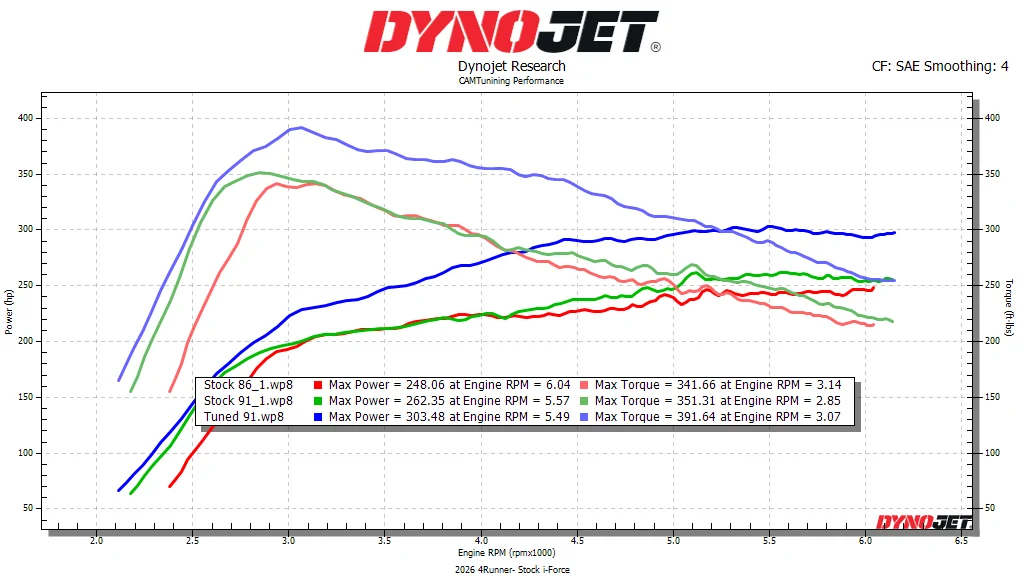
I'm back with the information I promised I would get. I spent almost three hours on the dyno, letting the vehicle cool down between runs, and I took the best of four runs in all cases.

One thing that I have characterized on both the 4Runner and the Tacoma is that the first run after an ECU reflash always reports lower power on the dyno. I have not quite nailed down why but it is something with ECU learning certainly.

On the stock tune with 91 octane the KCLV value was 18 to 19, meaning that the confidence level of the ECU was very high. When I first dynoed it on 86 octane it was 13 to 14, meaning that it was actively reducing timing. I did runs on the stock map and then I tuned the ECU on 91. You can see that in the very low RPM there was not a big difference but in the higher RPM when charge temps start to climb and knock is a lot more likely, the 2 curves diverge quite a bit. You will notice that I used a different base line here, and that's because we dynoed on 86 again, and it was warmer today. I wanted to have a direct, same condition comparison to keep everything as accurate as possible. This was the best of 4 runs, with the lowest being 242whp. 91 was added on a low tank, so there was still just a small amount of 86 in it.
In summary:
  • Peak HP was just over 14whp higher on 91 vs 86, and tq was ~10wtq higher. I didn't quite nail the run start on the 86 run, so I will say that the peak tq gains were likely a little less. What you'll note is that the hp and tq curves begin to really separate around 4200rpm, and stay apart.
  • You'll also note the bump in both 86 and 91 octane runs around 5000rpm. This has been present on every stock tuned 2.4T I've tuned. You'll note that it's not present in the 91 octane tune.
2025 2026 4runner 6th gen 2026 4Runner TRD Sport Dyno Results (Stock vs Tuned on 86 Octane) 1775787195192-0y
 
Last edited:

HVLA

TRD Off-Road Premium
Well-known member
Joined
Feb 28, 2025
Threads
9
Messages
558
Reaction score
376
Location
USA
Vehicle(s)
Lexus
I would be interested to see them...as long as the Dyno results show the same exact engine bone stock from factory in the same exact vehicle using an 87 octane gas AND again using a 91 octane gas. But to be very transparent, even if the results show an increase in HP I'll still be skeptical until I see official documentation from Toyota confirming & stating that fueling with mid grade or premium grade higher octane gasolines will increase HP.

I mean you kind of also have “skin in the game” since you seemingly make a living off of tuning engines, right?

Even if there is a 5-7% increase in HP somehow then I personally don't believe it's worth the increased cost of gasolines with higher than 87 octane unless the vehicle is being driven up mountains, loaded down with cargo or towing a heavy load. For the average driver, a minimal increase in HP isn't going to be perceptible in real world driving.
This has already been done by Stillen and you didnt believe it because you think Stillen somehow makes money on someone with a stock motor buying premium fuel instead of regular.
 

The_Dark_Knight_Forever

TRD Sport Premium
Well-known member
First Name
J.
Joined
Mar 31, 2025
Threads
8
Messages
272
Reaction score
110
Location
Houston, TX
Vehicle(s)
2003 Toyota Tundra SR5 TRD Sport Stepside
I'm back with the information I promised I would get. I spent almost three hours on the dyno, letting the vehicle cool down between runs, and I took the best of four runs in all cases.

One thing that I have characterized on both the 4Runner and the Tacoma is that the first run after an ECU reflash always reports lower power on the dyno. I have not quite nailed down why but it is something with ECU learning certainly.

On the stock tune with 91 octane the KCLV value was 18 to 19, meaning that the confidence level of the ECU was very high. When I first dynoed it on 86 octane it was 13 to 14, meaning that it was actively reducing timing. I did runs on the stock map and then I tuned the ECU on 91. You can see that in the very low RPM there was not a big difference but in the higher RPM when charge temps start to climb and knock is a lot more likely, the 2 curves diverge quite a bit. You will notice that I used a different base line here, and that's because we dynoed on 86 again, and it was warmer today. I wanted to have a direct, same condition comparison to keep everything as accurate as possible. This was the best of 4 runs, with the lowest being 242whp. 91 was added on a low tank, so there was still just a small amount of 86 in it.
In summary:
  • Peak HP was just over 14whp higher on 91 vs 86, and tq was ~10wtq higher. I didn't quite nail the run start on the 86 run, so I will say that the peak tq gains were likely a little less. What you'll note is that the hp and tq curves begin to really separate around 4200rpm, and stay apart.
  • You'll also note the bump in both 86 and 91 octane runs around 5000rpm. This has been present on every stock tuned 2.4T I've tuned. You'll note that it's not present in the 91 octane tune.
1775787195192-0y.webp
I commend you for efforts, time and participation in this community. This is notable information to have received & I don't dismiss it. I consider it at face value with very little doubt about the accuracy of the information you've graciously obtained & provided here. Thank you. 🙏🏻

It's interesting that there's a “minimal” increase in HP & TQ using 91 octane versus 86 octane which was stated previously...but again, as has been said previously, to the average commuter it won't be perceived while driving & in my opinion doesn't justify the added cost. Where it might make a difference is increasing efficiency and life expectancy of the overall engine processes & operation. But we are really discussing HP & TQ gains here. Also, I can only speculate that Toyota doesn't advertise the slight gains when using higher octane gasolines because the gains are negligible & not widely perceptible to a majority of drivers. Again, speculation about this on my part but I've yet to find or see any documented claims from Toyota on the topic.

Without a doubt though there is clear benefit to aftermarket tuning even when only using 86 octane. This I didn't doubt previously. I personally won't be seeking to have mine tuned because I simply don't need the main benefits it would provide nor what I imagine is increased stress overall from the increased outputs. I do respect those who choose to have theirs tuned though as they clearly have a need for or simply want the increased outputs based on their personal use case scenarios.

For my use case scenario & region, I plan to heed the suggestions of ChatGPT based on the graph you provided by choosing my gasoline grades (in Texas) strategically...
• Cool/Cold weeks/months = 87 octane
• Hot/Scorching weeks/months = 89 octane
• Towing/Heavy Cargo/Traversing Steep Inclines = 91-93 octane (I likely will never have a need for this.)
This is because I do tend to believe there is some small benefits of reduced stress on the engine processes & operations using 89 octane which I want for engine longevity...not because I believe the very minimal HP & TQ gains are worth paying more for. I don't see the tangible or financial benefits of fueling with 91-93 octane in my typical use case unless 87 and 89 octane are not available or unless I'm filling with Costco's 91-93 octane which is usually priced very competitively to surrounding brands' 89 octane gasoline.
 
Last edited:

HVLA

TRD Off-Road Premium
Well-known member
Joined
Feb 28, 2025
Threads
9
Messages
558
Reaction score
376
Location
USA
Vehicle(s)
Lexus
I commend you for efforts, time and participation in this community. This is notable information to have received & I don't dismiss it. I consider it at face value with very little doubt about the accuracy of the information.

It's interesting that there is a "minimal" increase in HP & TQ using 91 octane versus 86 octane which was stated previously...but again, as has been said previously, to the average commuter it won't be perceived while driving & in my opinion doesn't justify the added cost. Where it might make a difference is increasing efficiency and life expectancy of the overall engine processes & operation. But we are really discussing HP & TQ gains here. Also, I can only speculate that Toyota doesn't advertise the slight gains when using higher octane gasolines because the gains are very minimal & not widely perceptible to a large majority of drivers. Again, speculation about this on my part but I've yet to find or see any documented claims from Toyota on the topic.

Without a doubt though there is clear benefit to aftermarket tuning even when only using 86 octane. This I didn't doubt previously. I personally won't be seeking to have mine tuned because I simply don't need the main benefits it would provide nor what I imagine is increased stress overall from the increased outputs. I do respect those who choose to have theirs tuned though as they clearly have a need for or simply want the increased outputs based on their personal use case scenarios.

With that said, I plugged your chart into Chat GPT which sums things up nicely in my mind regarding the stock engine tune:

https://chatgpt.com/s/t_69d94c707e0c819196f8544e82a11c7e

For my use case scenario & region, I'll plan to heed the suggestion of ChatGPT & choose my gasoline grades strategically...
• Hot/Scorching weeks/months = 89 octane
• Cool/Cold weeks/months = 87 octane
This is because I do tend to believe there is some small benefits of reduced stress on the engine process & efficiency using 89 octane which I want for engine longevity...not because I believe the very minimal HP & TQ gains are worth paying more for. I don't see the tangible or financial benefits of fueling with 91-93 octane unless 87 and 89 octane are not available or unless I'm filling with Costco's 91-93 octane which is usually priced very competitively to surrounding brands' 89 octane gasoline.
The average commuter will absolutely notice the additional HP/TQ as it comes on at a lower rpm.
 

The_Dark_Knight_Forever

TRD Sport Premium
Well-known member
First Name
J.
Joined
Mar 31, 2025
Threads
8
Messages
272
Reaction score
110
Location
Houston, TX
Vehicle(s)
2003 Toyota Tundra SR5 TRD Sport Stepside
This has already been done by Stillen and you didnt believe it because you think Stillen somehow makes money on someone with a stock motor buying premium fuel instead of regular.
What I believe is that Stillen has a vested business & financial interest in high performance parts, aftermarket modifications, engine tuning & presenting results that encourage interested people to purchase parts/services that support the use of higher octane fuels for increased gains. I don't think it benefits directly from the purchase of the fuels (unless they are the retailer of them) but I do speculate that it's at least possible that it could be benefiting indirectly as it does promote & sell aftermarket high performance parts/services which produce the highest performance results from Premium grade fuels. Use your imagination.
 

HVLA

TRD Off-Road Premium
Well-known member
Joined
Feb 28, 2025
Threads
9
Messages
558
Reaction score
376
Location
USA
Vehicle(s)
Lexus
What I believe is that Stillen has a vested business & financial interest in high performance parts, aftermarket modifications, engine tuning & presenting results that encourage interested people to purchase parts/services that support the use of higher octane fuels for increased gains. I don't think it benefits directly from the purchase of the fuels (unless they are the retailer of them) but I do speculate that it's at least possible that it could be benefiting indirectly as it does promote & sell aftermarket high performance parts/services which produce the highest performance results from Premium grade fuels. Use your imagination.
The entire video that I am referring to is entirely about the difference of regular and premium fuel on a completely stock video. There is no incentive there at all.
 
OP
OP
CAMTuning

CAMTuning

TRD Off-Road
Well-known member
Site Sponsor
First Name
Cam
Joined
Nov 14, 2025
Threads
10
Messages
123
Reaction score
193
Location
NM
Vehicle(s)
2025 Tacoma TRD OffRoad
I commend you for efforts, time and participation in this community. This is notable information to have received & I don't dismiss it. I consider it at face value with very little doubt about the accuracy of the information you've graciously obtained & provided here. Thank you. 🙏🏻

It's interesting that there's a “minimal” increase in HP & TQ using 91 octane versus 86 octane which was stated previously...but again, as has been said previously, to the average commuter it won't be perceived while driving & in my opinion doesn't justify the added cost. Where it might make a difference is increasing efficiency and life expectancy of the overall engine processes & operation. But we are really discussing HP & TQ gains here. Also, I can only speculate that Toyota doesn't advertise the slight gains when using higher octane gasolines because the gains are negligible & not widely perceptible to a majority of drivers. Again, speculation about this on my part but I've yet to find or see any documented claims from Toyota on the topic.

Without a doubt though there is clear benefit to aftermarket tuning even when only using 86 octane. This I didn't doubt previously. I personally won't be seeking to have mine tuned because I simply don't need the main benefits it would provide nor what I imagine is increased stress overall from the increased outputs. I do respect those who choose to have theirs tuned though as they clearly have a need for or simply want the increased outputs based on their personal use case scenarios.

For my use case scenario & region, I plan to heed the suggestions of ChatGPT based on the graph you provided by choosing my gasoline grades (in Texas) strategically...
• Cool/Cold weeks/months = 87 octane
• Hot/Scorching weeks/months = 89 octane
• Towing/Heavy Cargo/Traversing Steep Inclines = 91-93 octane (I likely will never have a need for this.)
This is because I do tend to believe there is some small benefits of reduced stress on the engine processes & operations using 89 octane which I want for engine longevity...not because I believe the very minimal HP & TQ gains are worth paying more for. I don't see the tangible or financial benefits of fueling with 91-93 octane in my typical use case unless 87 and 89 octane are not available or unless I'm filling with Costco's 91-93 octane which is usually priced very competitively to surrounding brands' 89 octane gasoline.
I bet you I could change your mind about tuning. I can leave your power stock, but improve shifting behavior and it will change the entire driving experience. Take that with more power and torque and you’ve really done something.
 

The_Dark_Knight_Forever

TRD Sport Premium
Well-known member
First Name
J.
Joined
Mar 31, 2025
Threads
8
Messages
272
Reaction score
110
Location
Houston, TX
Vehicle(s)
2003 Toyota Tundra SR5 TRD Sport Stepside
I bet you I could change your mind about tuning. I can leave your power stock, but improve shifting behavior and it will change the entire driving experience. Take that with more power and torque and you’ve really done something.
I wouldn't mind having better shifting behavior honestly. The hard shifts I'm feeling early in my commutes until the transmission warms up is concerning. Others have reported it also of course.


Top