Sponsored
OP
OP
CAMTuning

CAMTuning

TRD Off-Road
Well-known member
Site Sponsor
First Name
Cam
Joined
Nov 14, 2025
Threads
5
Messages
52
Reaction score
57
Location
NM
Vehicle(s)
2025 Tacoma TRD OffRoad
Session 3:
What the ECU Is Doing When You See Throttle Closure


Sometimes when you’re reviewing a log, you’ll notice something that doesn’t quite match what your foot is doing.

The accelerator is down…
but the throttle isn’t fully open.

That can raise questions — especially if you’re new to looking at ECU data.

Let’s clear it up.

The Short Version

On the 2.4T Tacoma / 4Runner, the throttle is not a direct link to your foot.

It’s a torque management device.

This is not unique to Toyota.
Modern Ford and Volkswagen platforms use the throttle the same way — even at wide-open pedal.

The ECU uses throttle position as one of several tools to deliver the correct amount of torque for the current conditions.

Seeing throttle movement in a log is normal ECU behavior, not a problem by itself.

What Throttle Closure Is (And Isn’t)

Throttle closure is:
  • A normal torque control strategy
  • Used across modern OEM platforms
  • Part of how the ECU keeps power smooth and predictable
Throttle closure is not:
  • A malfunction
  • A sign of engine knock
  • The ECU “fighting” the tune
  • Something unique to tuned trucks
If you’ve logged a modern Ford or VW, you’ve seen this before — even on factory or OEM-performance calibrations.

Why the ECU Uses the Throttle

The ECU is constantly balancing:
  • Requested torque
  • Available airflow
  • Operating conditions (gear, speed, temperature)
  • Drivetrain protection
If delivering more airflow would exceed its internal torque model, the throttle is one of the cleanest and fastest ways to stay in control.

Spark, boost, and throttle all work together — the ECU simply uses whichever tool makes the most sense at that moment.

How This Relates to Knock Learning

Knock control and torque control are closely linked.

If the ECU becomes more conservative under certain conditions, it may adjust torque delivery.

Throttle position is one of several ways it does this — alongside spark and boost control.

This doesn’t mean knock is occurring.
It means the ECU is managing output intentionally.

What To Do This Week

If you notice throttle movement in a log, look at it in context:
  • Throttle angle vs pedal position
  • Gear
  • Intake Air Temperature
  • KCLV and KCA trends
Single events don’t tell much.
Patterns do.

Closing Thought

Throttle closure isn’t something to eliminate.

It’s one of the tools modern ECUs — Toyota, Ford, and VW alike — use to keep power consistent, smooth, and repeatable in the real world.

Once you understand why it happens,
it becomes useful information — not a concern.
 
OP
OP
CAMTuning

CAMTuning

TRD Off-Road
Well-known member
Site Sponsor
First Name
Cam
Joined
Nov 14, 2025
Threads
5
Messages
52
Reaction score
57
Location
NM
Vehicle(s)
2025 Tacoma TRD OffRoad
Session 4:
Fuel Trims, Rich vs Lean, and Why Boost Changes Everything

Fueling is one of the clearest windows into how healthy a calibration really is—if you know what you’re looking at.
Modern Toyota ECUs manage fuel using two main correction layers:
Short-Term Fuel Trim (STFT)
Fast, real-time adjustments used during light-load, closed-loop operation to keep fueling on target.
Long-Term Fuel Trim (LTFT)
Slower, learned corrections that reflect how the engine typically behaves over time.
Together, they tell you whether the ECU is making small refinements—or compensating for a deeper mismatch.
Rich vs Lean (in simple terms)
  • Lean = less fuel than expected
  • Rich = more fuel than expected
Neither is inherently wrong on its own. What matters is where in the operating range it happens.
At cruise and light throttle, the ECU intentionally targets an efficient mixture and uses trims to stay there.
Under boost, the strategy changes.
Why enrichment under boost matters
As load and cylinder pressure rise, combustion temperatures increase. To protect the engine and maintain consistent torque, the calibration transitions away from trim-based correction and into a commanded enrichment strategy. At this time the fueling target will become richer (.75 to .85 lambda: 11-12.5:1 AFR on gasoline).
  • There are no short-term fuel trims under boost
  • The ECU relies on modeled airflow and commanded fuel targets
  • Any learned long-term fuel trims can still be carried into higher load
If those learned trims are large, they can unintentionally influence fueling where accuracy matters most.
A healthy calibration:
  • Has minimal long-term correction
  • Transitions cleanly into enrichment
  • Delivers predictable fueling under load without chasing compensation
Discussion encouraged:
What questions do you have about fueling, trims, or air/fuel behavior that you’ve never gotten a clear answer to?
 
OP
OP
CAMTuning

CAMTuning

TRD Off-Road
Well-known member
Site Sponsor
First Name
Cam
Joined
Nov 14, 2025
Threads
5
Messages
52
Reaction score
57
Location
NM
Vehicle(s)
2025 Tacoma TRD OffRoad
Session 5:
Shift Schedules: RPM vs Output Shaft Speed (And Why Your Truck Feels the Way It Does)
If you’ve ever thought “this truck should’ve shifted already” or “why did it short-shift there?” — this post is for you.
Most people assume automatic transmissions shift purely based on engine RPM.
In reality, modern Toyota transmissions care much more about Output Shaft Speed (OSS).
What’s the difference?
  • Engine RPM tells you how fast the engine is spinning.
  • Output Shaft Speed tells the transmission how fast the vehicle is actually moving through the gears.
OSS accounts for:
  • Gear ratio
  • Torque converter behavior
  • Tire size
  • Load
  • Throttle input
That makes it a far more reliable signal for deciding when to shift.
Why this matters for drivability
Because shift schedules are often based on OSS:
  • Two pulls to the same RPM can shift at different road speeds
  • The truck may hold a gear longer under load, even at the same RPM
  • Light throttle can cause earlier, smoother shifts
  • Heavy throttle can delay shifts without increasing RPM targets
This is why changing engine power alone doesn’t always change how the truck feels to drive.
What tuning can (and can’t) influence
A refined calibration aligns:
  • Torque delivery
  • Throttle behavior
  • Shift timing
When these agree with the OSS-based strategy, the result is:
  • Fewer “busy” shifts
  • More predictable downshifts
  • Better part-throttle smoothness
  • A transmission that feels like it’s anticipating your intent
Discussion encouraged:
Have you noticed situations where the truck feels like it “should’ve shifted” but didn’t—or shifted when you didn’t expect it to?
 
OP
OP
CAMTuning

CAMTuning

TRD Off-Road
Well-known member
Site Sponsor
First Name
Cam
Joined
Nov 14, 2025
Threads
5
Messages
52
Reaction score
57
Location
NM
Vehicle(s)
2025 Tacoma TRD OffRoad
Session 6: Rotating Weight: Why Bigger Tires Feel Like Lost Power (and How Tuning Gets It Back)

Let’s take a quick break from sensors, trims, and tables and talk about something you can feel immediately behind the wheel: rotating weight.

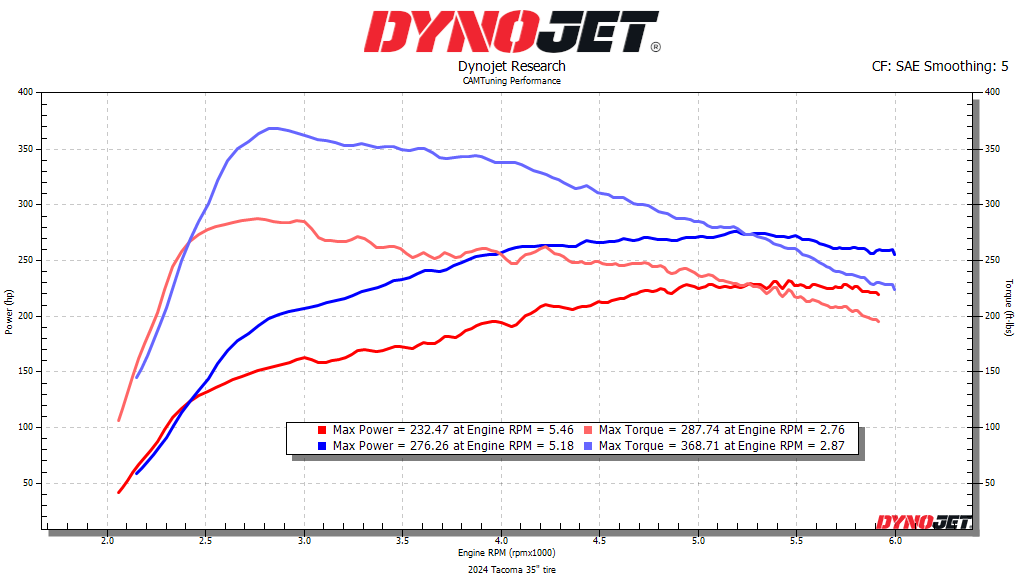
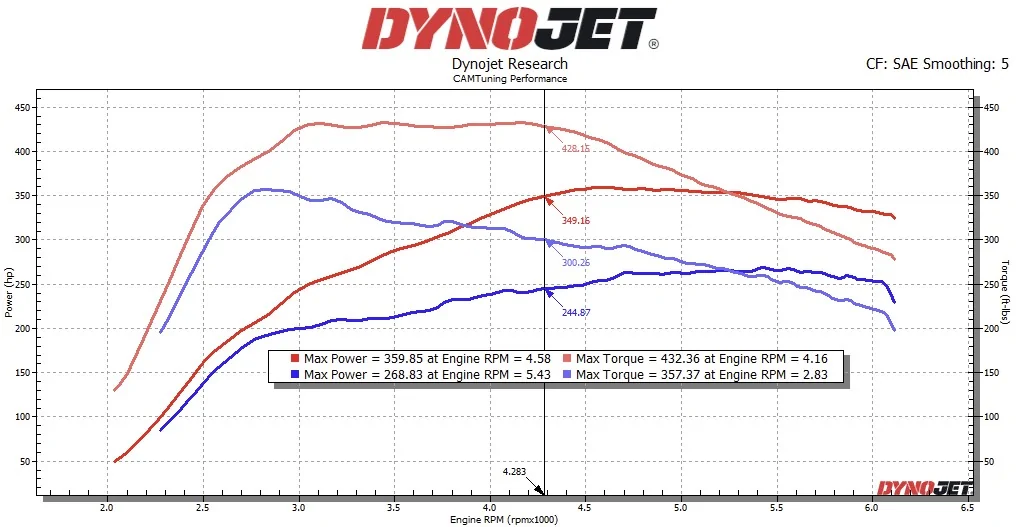
Earlier this week I had a Tacoma on the dyno running significantly heavier tire and wheel combo than stock. No engine changes. Same truck. Same dyno. The only variable was rotating mass.
(These tires are ~65lbs each, on factory wheels)
The baseline result was exactly what you’d expect:
  • Lower measured power
  • Slower acceleration
  • A drivetrain that had to work harder to do the same job
But here’s the part most people miss.

That “lost power” isn’t gone — it’s being used.

Why rotating weight matters more than vehicle weight

Rotating mass (tires, wheels, driveshafts) doesn’t just need to be moved forward — it has to be spun. That means:
  • More torque required to accelerate
  • More load on the engine and transmission
  • Slower rate of RPM change
  • Heavier demand during shifts

This is why trucks often feel:
  • Sluggish after tire upgrades
  • Lazy to downshift
  • Less responsive at part throttle
What the dyno showed

Despite the heavier setup, once calibrated correctly:
  • Torque gains were equal to—or better than—stock-tire trucks
  • Throttle response improved noticeably
  • The power curve became smoother and more usable
2025 4runner 6th gen Tuning Facts - Understand Your 4Runner Like We Do at CAMTuning 2024 non  hybrid tacoma 35i


The tune didn’t “add magic horsepower.”
It reclaimed efficiency that the stock calibration wasn’t designed to preserve with heavier rotating mass.


OEM calibrations are built for factory tires.
Once you change that equation, the strategy needs to change too.

The takeaway

Big tires don’t ruin performance — unaddressed calibration does.

When torque delivery, throttle behavior, and shift strategy are aligned for the added rotating mass, the truck stops feeling heavy and starts feeling intentional again.
 
OP
OP
CAMTuning

CAMTuning

TRD Off-Road
Well-known member
Site Sponsor
First Name
Cam
Joined
Nov 14, 2025
Threads
5
Messages
52
Reaction score
57
Location
NM
Vehicle(s)
2025 Tacoma TRD OffRoad
Day late this time around. Just spent the last several days with the Cobb crew at the King of the Hammers. I've never been to that event but it's something you have to experience to understand!
Easy reading this week!

Session 7: Throttle ≠ Power


Not every throttle input needs full power. A lot of what people describe as “lag” or “soft response” is really just factory pedal mapping trying to cover every possible driver and condition.


A proper ECU calibration focuses on making small pedal inputs smooth and predictable. That’s what keeps the truck from feeling jumpy around town or hard to modulate off-road. The goal isn’t to make the truck aggressive—it’s to make it easy to drive.


This is also where ECU tuning differs from pedal-commander–type devices. Those only change how quickly the throttle opens for a given pedal input. They can make the truck feel more responsive, but they don’t change torque management, cam timing, fueling, or how the engine and transmission actually work together.


With real tuning, pedal mapping is just one part of a bigger picture. When everything is aligned, you end up with more usable power, not just sharper tip-in.


That’s the difference between a truck that feels quick when you touch the pedal and one that feels right everywhere.
 

Vincenzo

TRD Sport Premium
Well-known member
Joined
Mar 27, 2025
Threads
6
Messages
260
Reaction score
181
Location
Southeast
Vehicle(s)
Toyota
I have been considering Banks Pedal Monster. I have their intake. You just explained that a tune corrects the pedal lag. Boost tubes? Waste of money? Have you done any testing, with or without, any of the few offerings. Every day I get closer and closer to purchasing your product. My biggest concerns with my 4Runner are the pedal lag and transmission shifting. I am old school and yearn for the good old days of being able to put in a shift kit #fairbanks. The pedal lag is not as bad as other vehicles I’ve driven. It is very annoying though. I notice that the 87 tune has the flattest curves. Why is that? We have REC fuel here and that is what I use. Depending where I buy, it could be 89 one place or 90 at another. Have you tuned with the REC?
 
OP
OP
CAMTuning

CAMTuning

TRD Off-Road
Well-known member
Site Sponsor
First Name
Cam
Joined
Nov 14, 2025
Threads
5
Messages
52
Reaction score
57
Location
NM
Vehicle(s)
2025 Tacoma TRD OffRoad
I have been considering Banks Pedal Monster. I have their intake. You just explained that a tune corrects the pedal lag. Boost tubes? Waste of money? Have you done any testing, with or without, any of the few offerings. Every day I get closer and closer to purchasing your product. My biggest concerns with my 4Runner are the pedal lag and transmission shifting. I am old school and yearn for the good old days of being able to put in a shift kit #fairbanks. The pedal lag is not as bad as other vehicles I’ve driven. It is very annoying though. I notice that the 87 tune has the flattest curves. Why is that? We have REC fuel here and that is what I use. Depending where I buy, it could be 89 one place or 90 at another. Have you tuned with the REC?
Boost tubes won’t be a significant, driver-detectable improvement, especially once you factor in an intake and a proper tune. They mostly shift throttle signal behavior and don’t change torque management or transmission logic, so real-world gains are minimal.

I’m with you on being old school — I remember the shift-kit days too (B&M all the way). Being able to firm up shifts completely changed how a vehicle felt. These days, tuning is the closest thing we have, and honestly that’s where the biggest difference shows up.

Power is easy. What you actually feel every day is shift performance. A good tune tightens shift behavior, reduces gear hunting, and makes the truck feel intentional instead of lazy. Pedal response improves too, but transmission behavior is the real win.

As for REC fuel — I’ve tuned extensively on ethanol-free 89–90 octane and it works well. I’m curious though: what’s your preference for REC over E10?
 

Vincenzo

TRD Sport Premium
Well-known member
Joined
Mar 27, 2025
Threads
6
Messages
260
Reaction score
181
Location
Southeast
Vehicle(s)
Toyota
Boost tubes won’t be a significant, driver-detectable improvement, especially once you factor in an intake and a proper tune. They mostly shift throttle signal behavior and don’t change torque management or transmission logic, so real-world gains are minimal.

I’m with you on being old school — I remember the shift-kit days too (B&M all the way). Being able to firm up shifts completely changed how a vehicle felt. These days, tuning is the closest thing we have, and honestly that’s where the biggest difference shows up.

Power is easy. What you actually feel every day is shift performance. A good tune tightens shift behavior, reduces gear hunting, and makes the truck feel intentional instead of lazy. Pedal response improves too, but transmission behavior is the real win.

As for REC fuel — I’ve tuned extensively on ethanol-free 89–90 octane and it works well. I’m curious though: what’s your preference for REC over E10?
Because it makes gasoline less volatile. You can tune race vehicles to properly run on ethanol but for real world applications it ruins performance and ultimately mpgs in street driven vehicles in my opinion. Did a little test in a Silverado I owned at one time. It had real time fuel monitoring. Ran a tank of E85 and was getting 12 mpgs. 14 mpgs on E15 and 16 mpgs on REC90. I had a Tacoma that was consistently getting 19 mpgs pre E85. When the switch went through to ethanol it killed gas mileage and was only getting 15 mpgs after that. In real world applications, ethanol has zero benefit other than “watering“ down gasoline
 
OP
OP
CAMTuning

CAMTuning

TRD Off-Road
Well-known member
Site Sponsor
First Name
Cam
Joined
Nov 14, 2025
Threads
5
Messages
52
Reaction score
57
Location
NM
Vehicle(s)
2025 Tacoma TRD OffRoad
Because it makes gasoline less volatile. You can tune race vehicles to properly run on ethanol but for real world applications it ruins performance and ultimately mpgs in street driven vehicles in my opinion. Did a little test in a Silverado I owned at one time. It had real time fuel monitoring. Ran a tank of E85 and was getting 12 mpgs. 14 mpgs on E15 and 16 mpgs on REC90. I had a Tacoma that was consistently getting 19 mpgs pre E85. When the switch went through to ethanol it killed gas mileage and was only getting 15 mpgs after that. In real world applications, ethanol has zero benefit other than “watering“ down gasoline
I understand why this feels true, especially when you’re watching real-time MPG numbers. But a few things are getting mixed together.

Modern fuel-injected vehicles are designed and calibrated around E10. Fuel trims, knock control, cold starts—all of it assumes some ethanol is present. When you run E0, the ECU doesn’t magically recalibrate itself; it just has to correct more to hit the same lambda. That usually means larger fuel trims, not cleaner or more efficient operation.

Ethanol also isn’t “watering down” gasoline. It’s simply a fuel with lower energy per gallon. That’s why MPG drops on E15 or E85—it takes more fuel to make the same power. That’s physics, not poor combustion or volatility. For reference, E85 is still 105+ octane, so it’s clearly not inferior fuel.

And this part actually lines up with your Silverado and Tacoma experience:
naturally aspirated, stock trucks don’t benefit from ethanol’s octane. Without higher compression, more timing, or boost, there’s no performance upside—only reduced MPG due to energy density. So yes, you saw fewer miles per gallon, exactly as expected.

One important note though: 91-octane E10 is still better than 89-octane E0. Ethanol is an octane adder, and modern ECUs care far more about knock margin than fuel volatility.

So in real-world, stock applications, ethanol doesn’t hurt performance—it just doesn’t help unless the engine is built or tuned to use it. The MPG change alone doesn’t mean it’s bad fuel; it just means the engine isn’t taking advantage of what ethanol is good at.
 

Vincenzo

TRD Sport Premium
Well-known member
Joined
Mar 27, 2025
Threads
6
Messages
260
Reaction score
181
Location
Southeast
Vehicle(s)
Toyota
I understand why this feels true, especially when you’re watching real-time MPG numbers. But a few things are getting mixed together.

Modern fuel-injected vehicles are designed and calibrated around E10. Fuel trims, knock control, cold starts—all of it assumes some ethanol is present. When you run E0, the ECU doesn’t magically recalibrate itself; it just has to correct more to hit the same lambda. That usually means larger fuel trims, not cleaner or more efficient operation.

Ethanol also isn’t “watering down” gasoline. It’s simply a fuel with lower energy per gallon. That’s why MPG drops on E15 or E85—it takes more fuel to make the same power. That’s physics, not poor combustion or volatility. For reference, E85 is still 105+ octane, so it’s clearly not inferior fuel.

And this part actually lines up with your Silverado and Tacoma experience:
naturally aspirated, stock trucks don’t benefit from ethanol’s octane. Without higher compression, more timing, or boost, there’s no performance upside—only reduced MPG due to energy density. So yes, you saw fewer miles per gallon, exactly as expected.

One important note though: 91-octane E10 is still better than 89-octane E0. Ethanol is an octane adder, and modern ECUs care far more about knock margin than fuel volatility.

So in real-world, stock applications, ethanol doesn’t hurt performance—it just doesn’t help unless the engine is built or tuned to use it. The MPG change alone doesn’t mean it’s bad fuel; it just means the engine isn’t taking advantage of what ethanol is good at.
So, let’s tune this thing with E85
 

CuttingedgeSport

TRD Sport Premium
Active member
Joined
Apr 20, 2025
Threads
1
Messages
31
Reaction score
33
Location
Wisconsin
Vehicle(s)
2025 TRD Sport 4wd
How much horsepower and torque on E10 91, REC 91, and E30 do you believe the stock injectors can control with some margin of safety of the duty cycles (port+direct)?

Can you tune INJPW on both the port and direct injectors on this setup? Are the port injectors a standard size that could be easily upgraded?

Here in Northern Wisconsin, I haven’t found any 93 octane anywhere yet, but Ethanol free 91 is standard at all Kwik Trip stations. They also have E85 at almost all Kwik trips.
 
Last edited:
OP
OP
CAMTuning

CAMTuning

TRD Off-Road
Well-known member
Site Sponsor
First Name
Cam
Joined
Nov 14, 2025
Threads
5
Messages
52
Reaction score
57
Location
NM
Vehicle(s)
2025 Tacoma TRD OffRoad
How much horsepower and torque on E10 91, REC 91, and E30 do you believe the stock injectors can control with some margin of safety of the duty cycles (port+direct)?

Can you tune INJPW on both the port and direct injectors on this setup? Are the port injectors a standard size that could be easily upgraded?

Here in Northern Wisconsin, I haven’t found any 93 octane anywhere yet, but Ethanol free 91 is standard at all Kwik Trip stations. They also have E85 at almost all Kwik trips.
I’m not seeing the stock fuel system as a limitation so far—even pushing higher ethanol blends. I’ve run up to ~E55 on my own truck without any fueling issues in the logs. That said, we’ll confirm the real ceiling through continued development on the stock turbo, and then on larger turbos (we have a couple ready to test).
Right now Cobb doesn’t allow direct control of the PI/DI split. It’s on the development list, but currently the ECU manages that strategy. We haven’t explored PI upgrades yet, but I don’t expect that side to be difficult if needed.
We only have 91 in New Mexico, and that’s what I run on my truck and customers’ trucks. If you want the best balance, E30 is ideal—better knock resistance without the cold-start quirks of higher blends. I run an Innovate flex fuel sensor with the gauge tucked in the glove box and switch to my E30 tune when I want the extra margin, but daily on 91.


Top