
Sponsored

How long can 12 Volt Battery sit unused without trickle charger and still start the 4Runner ?

william johnson

TRD Off-Road Premium
New member
Joined
May 31, 2026
Threads
3
Messages
4
Reaction score
0
Location
los angeles
Vehicle(s)
2026 4runner iforce max
Generally how long can a 2026 4Runner sit unused without a trickle charger before the 12 volt battery becomes too weak to start the car. I have gone 11 days without a problem. I plan to store the car several months and have a person drive it for 30 minutes periodically and want to know how often I should schedule those drives.
Sponsored


 

127.0.0.1

SR5
Well-known member
Joined
Oct 9, 2025
Threads
5
Messages
861
Reaction score
745
Location
earf
Vehicle(s)
a bunch of Toyotas
there is constant draw on that battery powering evap and radio transceivers

for ice-only
4 weeks is getting risky, 8 weeks it likely won't start

if it's gonna be parked... (at the expense of losing custom settings) just disconnect
the battery it'll last many months if in controlled temps

if you are doing drive cycles... 30 mins on road (not stop and go) or highway every 2 weeks should keep it fresh
 

RunnerRocks

TRD Off-Road Premium
Well-known member
First Name
RedDog
Joined
Dec 15, 2025
Threads
8
Messages
443
Reaction score
294
Location
Nature
Vehicle(s)
2026 TRD ORP (non-hybrid)
For our ORP non-hybrid, we have let it sit for three months without starting. Battery condition indicator was still "Blue: Good condition". Started right up, went for a drive, no problems, no resets required.
 

Nodak

Platinum
Well-known member
First Name
JR
Joined
Jan 22, 2025
Threads
68
Messages
2,837
Reaction score
1,595
Location
ND
Vehicle(s)
2026 4R Platinum Underground, 2025 4R Platinum Heritage Blue
your best bet is to just disconnect the negative lead if you are gone more than week and you dont mind driving habits and other things resetting to defaults.

and even during our brutal cold snaps, just sitting from thursday night until monday morning, the battery loses enough CCA to not even start sitting in a unheated garage.

i've had to run a trickle charger when it sat over the weekend (i work 4x10's so i have 3 day weekends all the time, sometimes 4 day weekends with a holiday)

its going to be interesting with this 4R since the battery is in the rear hatch area now instead of under the hood in the 2014 4R
 

ScoMay

TRD Pro
Well-known member
Joined
Mar 29, 2025
Threads
0
Messages
127
Reaction score
54
Location
Tennessee
Vehicle(s)
2022 Ram 1500 Rebel
Generally how long can a 2026 4Runner sit unused without a trickle charger before the 12 volt battery becomes too weak to start the car. I have gone 11 days without a problem. I plan to store the car several months and have a person drive it for 30 minutes periodically and want to know how often I should schedule those drives.
Last fall my hybrid was left for 3 months w/o running it and not connected to a maintainer. I was out of town for all that time. It started right up when I returned home.

It was only 5 months old at the time. And it was in a heated garage, not exposed to cold overnight temps.

Nowadays I connect it to a maintainer when there is a long-ish period of inactivity (3 weeks or more).
 

ScoMay

TRD Pro
Well-known member
Joined
Mar 29, 2025
Threads
0
Messages
127
Reaction score
54
Location
Tennessee
Vehicle(s)
2022 Ram 1500 Rebel
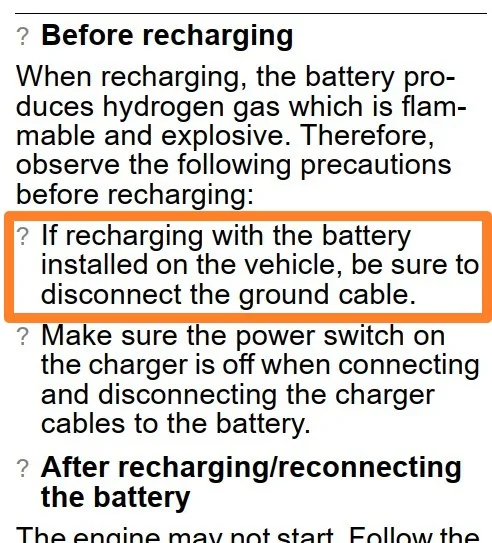
Do you disconnect the ground cable ?

Charging.webp
Thank you for pointing that detail out. I will check my hybrid manual and act accordingly.

I wonder if that means the interior of the 4R is potentially filling up with hydrogen gas? (Both chassis battery and hybrid pack are in the interior.)
 

Nodak

Platinum
Well-known member
First Name
JR
Joined
Jan 22, 2025
Threads
68
Messages
2,837
Reaction score
1,595
Location
ND
Vehicle(s)
2026 4R Platinum Underground, 2025 4R Platinum Heritage Blue
Thank you for pointing that detail out. I will check my hybrid manual and act accordingly.

I wonder if that means the interior of the 4R is potentially filling up with hydrogen gas? (Both chassis battery and hybrid pack are in the interior.)
if you read further in the manual, there is a drain tube for expelling gas to the exterior. sad part you need a replacement that has this attachment technically but you dont have to. thats a risk you have to decide if you want to go that route.
 

josiahg52

Trailhunter
Well-known member
First Name
Josiah
Joined
Jun 6, 2026
Threads
2
Messages
334
Reaction score
174
Location
Maine, United States
Vehicle(s)
2026 Trailhunter, 2018 Ram 2500, 2001 BMW M5, 2001 BMW X5 35d
Clearly, a battery charger or maintainer cannot charge the battery with the vehicle's negative cable disconnected unless the charger is connected directly to the battery terminals.

Given the confined space and limited electrical clearances in the 4Runner's rear battery compartment, disconnecting the negative cable first is a sensible precaution to reduce the risk of an accidental short circuit and resulting spark, particularly in the possible presence of hydrogen gas. This is standard battery-service practice: disconnect the ground cable first and reconnect it last. The same underlying safety principle explains the prescribed sequence for connecting and disconnecting jumper cables between vehicles.

However, disconnecting the negative cable does not eliminate hydrogen or the possibility of a spark. A spark can still occur when the battery circuit is reestablished by reconnecting the final terminal. The appropriate protection against hydrogen accumulation is adequate ventilation to keep its concentration below flammable limits, along with minimizing potential ignition sources.

Hydrogen generation is inherent to lead-acid battery charging, whether the charging current is supplied by the vehicle's charging system or an external battery charger. The amount of gas generated depends on battery chemistry, charging conditions, and the battery's state of charge.

Because the 4Runner's 12-volt battery is installed within the vehicle, Toyota must account for normal charging-related gas emissions. The factory battery vent tube directs gases outside the vehicle, reducing the potential for hydrogen accumulation in the enclosed battery compartment and passenger area.

Disconnecting the negative battery cable does not prevent hydrogen generation or accumulation. It primarily reduces the risk of an accidental short circuit while working directly at the battery. Moreover, disconnecting and reconnecting that cable introduces additional opportunities for arcing near the battery.

Charging through the designated under-hood connections presents a different ignition-risk arrangement. The charging connections are made away from the rear battery compartment, and the battery's existing electrical connections remain undisturbed. This does not eliminate all possible hazards, but it avoids introducing additional connection and disconnection operations immediately adjacent to the battery.

Consequently, I do not see how the hydrogen warning, by itself, establishes a reason to prohibit charging through the under-hood connections. If Toyota has identified a specific electrical or safety limitation associated with using those terminals for charging, the owner's manual should clearly state that restriction.

I have found no electrical reason why the 4Runner's 12-volt battery cannot be charged through the designated under-hood jump-start connections. The owner's manual does not identify any specific hazard to the vehicle, its occupants, the battery, or its electrical systems arising from using those connections for charging rather than jump-starting.

Technical documentation does not need to anticipate and expressly prohibit every conceivable use of a component. However, if a particular connection is intended exclusively for jump-starting because other uses present a hazard or are technically unsuitable, the manual should clearly establish that limitation. A simple statement that the terminals are approved only for jump-starting, and not for other purposes, would eliminate the ambiguity.

As written, the manual describes the procedures without establishing why charging through the under-hood connections would be unsafe or inappropriate.

Ive been professionally involved in cell and battery design, specification, production and maintenance, primarily lead-acid, for over 25 years.
 

ScoMay

TRD Pro
Well-known member
Joined
Mar 29, 2025
Threads
0
Messages
127
Reaction score
54
Location
Tennessee
Vehicle(s)
2022 Ram 1500 Rebel
Clearly, a battery charger or maintainer cannot charge the battery with the vehicle's negative cable disconnected unless the charger is connected directly to the battery terminals.

Given the confined space and limited electrical clearances in the 4Runner's rear battery compartment, disconnecting the negative cable first is a sensible precaution to reduce the risk of an accidental short circuit and resulting spark, particularly in the possible presence of hydrogen gas. This is standard battery-service practice: disconnect the ground cable first and reconnect it last. The same underlying safety principle explains the prescribed sequence for connecting and disconnecting jumper cables between vehicles.

However, disconnecting the negative cable does not eliminate hydrogen or the possibility of a spark. A spark can still occur when the battery circuit is reestablished by reconnecting the final terminal. The appropriate protection against hydrogen accumulation is adequate ventilation to keep its concentration below flammable limits, along with minimizing potential ignition sources.

Hydrogen generation is inherent to lead-acid battery charging, whether the charging current is supplied by the vehicle's charging system or an external battery charger. The amount of gas generated depends on battery chemistry, charging conditions, and the battery's state of charge.

Because the 4Runner's 12-volt battery is installed within the vehicle, Toyota must account for normal charging-related gas emissions. The factory battery vent tube directs gases outside the vehicle, reducing the potential for hydrogen accumulation in the enclosed battery compartment and passenger area.

Disconnecting the negative battery cable does not prevent hydrogen generation or accumulation. It primarily reduces the risk of an accidental short circuit while working directly at the battery. Moreover, disconnecting and reconnecting that cable introduces additional opportunities for arcing near the battery.

Charging through the designated under-hood connections presents a different ignition-risk arrangement. The charging connections are made away from the rear battery compartment, and the battery's existing electrical connections remain undisturbed. This does not eliminate all possible hazards, but it avoids introducing additional connection and disconnection operations immediately adjacent to the battery.

Consequently, I do not see how the hydrogen warning, by itself, establishes a reason to prohibit charging through the under-hood connections. If Toyota has identified a specific electrical or safety limitation associated with using those terminals for charging, the owner's manual should clearly state that restriction.

I have found no electrical reason why the 4Runner's 12-volt battery cannot be charged through the designated under-hood jump-start connections. The owner's manual does not identify any specific hazard to the vehicle, its occupants, the battery, or its electrical systems arising from using those connections for charging rather than jump-starting.

Technical documentation does not need to anticipate and expressly prohibit every conceivable use of a component. However, if a particular connection is intended exclusively for jump-starting because other uses present a hazard or are technically unsuitable, the manual should clearly establish that limitation. A simple statement that the terminals are approved only for jump-starting, and not for other purposes, would eliminate the ambiguity.

As written, the manual describes the procedures without establishing why charging through the under-hood connections would be unsafe or inappropriate.

Ive been professionally involved in cell and battery design, specification, production and maintenance, primarily lead-acid, for over 25 years.

Very thorough and clear explanation of a situation that the manual does not really clarify. Thank you for writing this.

I know that other forum members have used those under-the-hood connection points to connect a permanently installed plug-in for an external maintainer. No mention from them of plugging in at the grill and then disconnecting the ground cable on the battery itself.

In a related note, it has always seemed odd to me that the chassis battery is in the interior. I am aware of the presence of a vent tube, but have wondered since day 1 what could happen if it became disconnected or plugged up with gunk at the outlet somewhere underneath the vehicle. Would I then be unknowingly breathing hydrogen gas whenever I am driving as the electric motor charges the “auxiliary “ battery??
Sponsored


Top