Sponsored

CAMTuning

TRD Off-Road
Well-known member
Site Sponsor
First Name
Cam
Joined
Nov 14, 2025
Threads
17
Messages
189
Reaction score
301
Location
NM
Vehicle(s)
2025 Tacoma TRD OffRoad
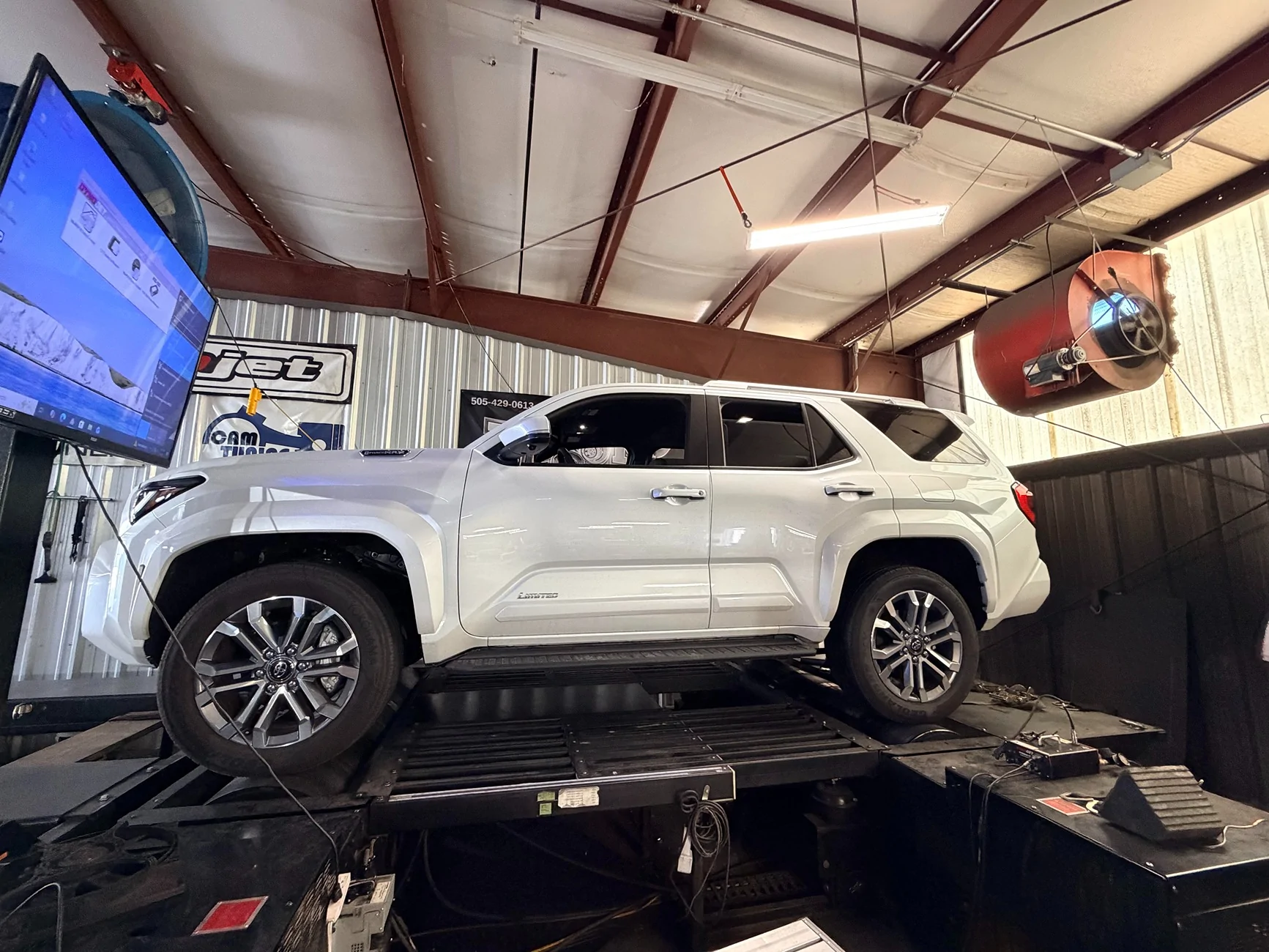
Today I had a completely stock, 4,000-mile 2026 full-time four-wheel-drive 4Runner on the dyno. All testing was completed on 91 octane with the transmission locked in fourth gear for both the stock and tuned pulls.

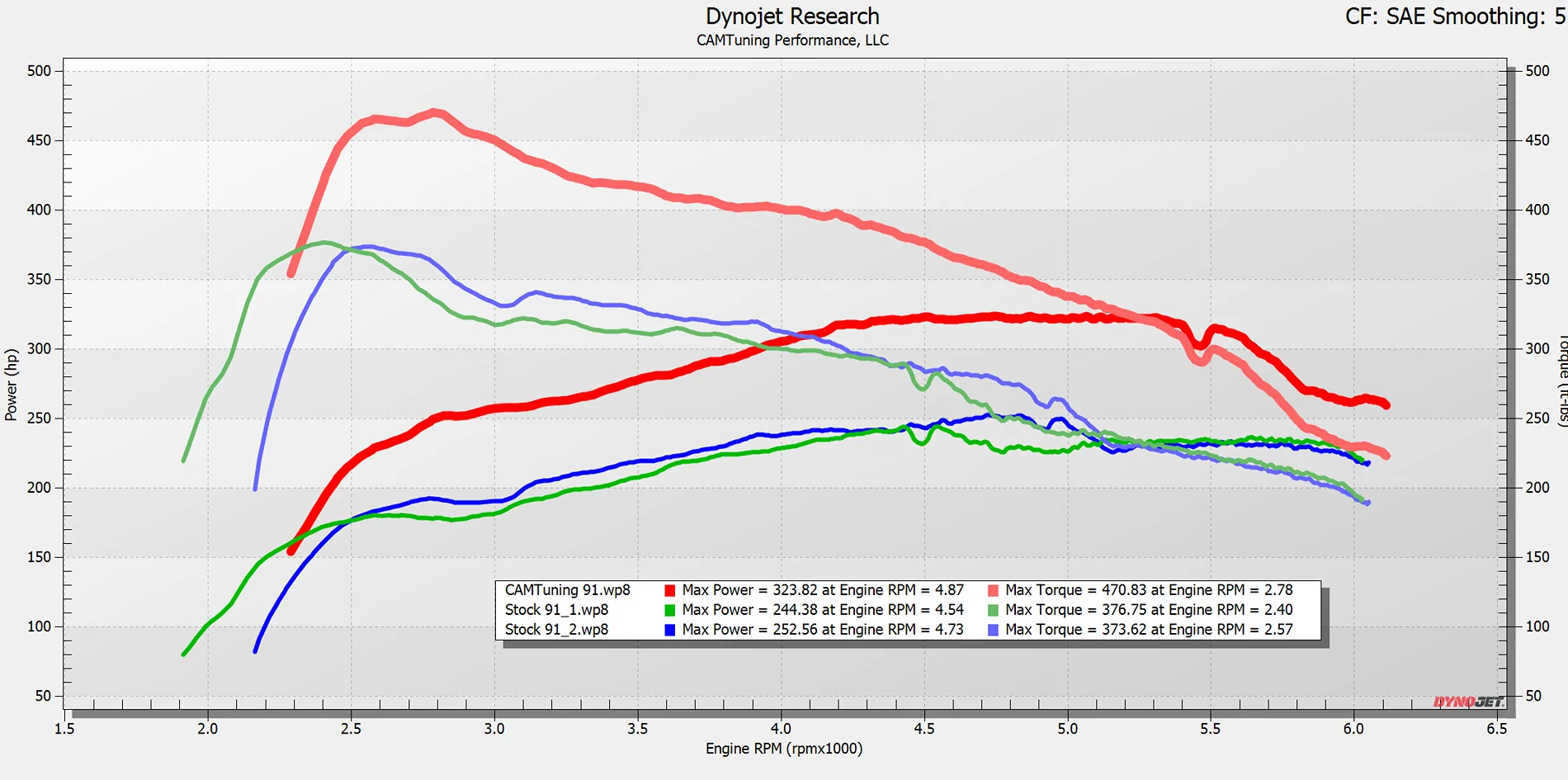
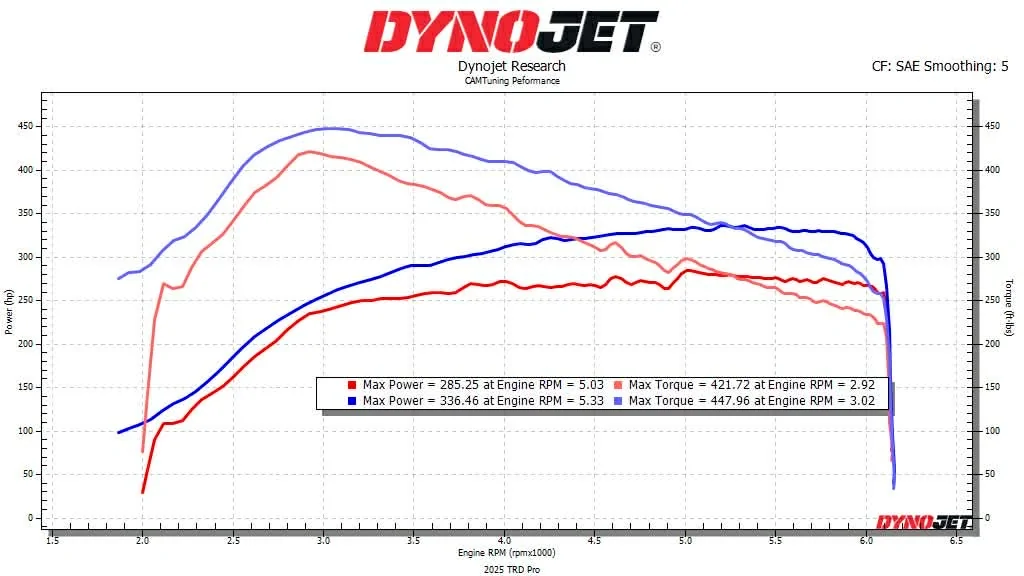
The repeatable stock baseline produced 252.56 wheel horsepower and 373.62 lb-ft of torque. After tuning, it produced 323.82 wheel horsepower and 470.83 lb-ft of torque, for gains of 71 wheel horsepower and 97 lb-ft.

The peak numbers are strong, but the bigger story is the improvement throughout the entire usable powerband. From 3,000 to 4,000 rpm, the tune averaged approximately 60 additional wheel horsepower and 91 lb-ft of torque. From 4,000 to 5,000 rpm, the average gain increased to approximately 75 wheel horsepower and 87 lb-ft. Even from 5,000 to 6,000 rpm, it still averaged roughly 72 wheel horsepower and 70 lb-ft more than stock.

The largest measured torque improvement was approximately 117 lb-ft at 3,000 rpm. The largest horsepower difference was approximately 96 wheel horsepower at 5,200 rpm, where the tuned run was still producing more than 322 wheel horsepower compared with approximately 227 wheel horsepower stock.

That is what makes the result more meaningful than the peak numbers alone. The tune adds a substantial amount of torque through the low and midrange, then continues carrying significantly more horsepower as rpm increases. This is not a narrow gain at one point on the graph. The entire curve is improved.

I also included the first stock pull to show something I consistently observe on these trucks: the first pull usually makes less power than the following pull. This one made 244.38 wheel horsepower compared with 252.56 on the second stock pull.

I intentionally did not use the lower first pull as the baseline. I have seen people use that weaker first run in a stock-versus-tuned comparison because it makes the gains look larger, but I do not consider that an honest representation of the result.

I do my best to begin each dyno sample at the same engine speed so the curves line up and the comparison is easy to read. On the first stock pull, however, I unintentionally began the sample at a lower rpm, which is why that curve is visibly shifted to the left. Starting a pull earlier will also usually produce a higher low-end torque reading on the dyno because the vehicle has more time to build load before reaching that portion of the curve.

This is another detail worth paying attention to when reviewing dyno charts. Differences in where the sample begins can change the apparent shape and low-end torque of the graph, even when the vehicle itself has not changed.

There is also a noticeable dip near the upper end of the pull. It appears on both the stock and tuned calibrations and can be felt from the driver’s seat. My current suspicion is a reduction or transition in hybrid motor assist, or another factory torque-management event. I would need more hybrid-system data before calling the exact cause, but it is clearly not something introduced by the tune and it is not just a graphing artifact.

While this was performed on the dyno, the vast majority of my customers are tuned remotely, using the same methodology. Flash- log- review- revise, repeat.

2025 2026 4runner 6th gen 2026 Hybrid 4Runner Dyno results - Custom tune vs stock (+71whp/97wtq) dyno pic


2025 2026 4runner 6th gen 2026 Hybrid 4Runner Dyno results - Custom tune vs stock (+71whp/97wtq) 1785542004857-7f
Sponsored


Nodak

Platinum
Well-known member
First Name
JR
Joined
Jan 22, 2025
Threads
62
Messages
2,639
Reaction score
1,487
Location
ND
Vehicle(s)
2025 4R Platinum Heritage Blue , 2026 4R Platinum Underground (Pending)
so i am guessing the gains are purely engine output w/o the hybrid motor assisting?

i guess if you add the hybrid motor specs to your tune you should get more than the official specs ?

base motor w/o hybrid

i-FORCE 2.4L turbocharged inline 4-cylinder engine; 278 hp @ 6000 rpm; 317 lb.-ft. @ 1700 rpm
Parallel hybrid system with permanent magnet synchronous motor/generator; Electric motor power: 48 hp (36 kW); Electric motor torque: 184 lb.-ft. (250 N•m)
 
Last edited:
OP
OP
CAMTuning

CAMTuning

TRD Off-Road
Well-known member
Site Sponsor
First Name
Cam
Joined
Nov 14, 2025
Threads
17
Messages
189
Reaction score
301
Location
NM
Vehicle(s)
2025 Tacoma TRD OffRoad
so i am guessing the gains are purely engine output w/o the hybrid motor assisting?

i guess if you add the hybrid motor specs to your tune you should get more than the official specs ?
The dyno is measuring the combined output at the wheels, so the hybrid system is contributing during the pull. The gains shown are the increase in wheel horsepower and wheel torque over stock.


The factory ratings, on the other hand, are crankshaft ratings measured at the engine before the drivetrain. Those numbers don’t account for the power lost through the transmission, transfer case, differentials, and tires before it reaches the ground.


So you can’t directly add my wheel horsepower gains to Toyota’s published engine or hybrid specs. They’re measured in different places using different standards. The important comparison is stock vs. tuned on the same dyno, under the same conditions, because that isolates the actual improvement at the wheels.
 

Nodak

Platinum
Well-known member
First Name
JR
Joined
Jan 22, 2025
Threads
62
Messages
2,639
Reaction score
1,487
Location
ND
Vehicle(s)
2025 4R Platinum Heritage Blue , 2026 4R Platinum Underground (Pending)
that is kinda odd that a hybrid would lose over 100 ft lbs of torque and 75 hp at the wheels by your numbers (baseline)

The repeatable stock baseline produced 252.56 wheel horsepower and 373.62 lb-ft of torque. After tuning

oem hybrid specs

i-FORCE MAX 2.4L turbocharged inline 4-cylinder hybrid powertrain; 326 hp @ 6000 rpm; 465 lb.-ft. @ 1700 rpm; Trailhunter: 323 hp @ 6000 rpm
oh well, thanks for the numbers (y)
 

Dead Horse

TRD Off-Road Premium
Well-known member
Joined
Sep 6, 2024
Threads
3
Messages
577
Reaction score
651
Location
Oklahoma
Vehicle(s)
4Runner
How do you even tune these? Did Toyota stop locking down the ECM?
 
OP
OP
CAMTuning

CAMTuning

TRD Off-Road
Well-known member
Site Sponsor
First Name
Cam
Joined
Nov 14, 2025
Threads
17
Messages
189
Reaction score
301
Location
NM
Vehicle(s)
2025 Tacoma TRD OffRoad
How do you even tune these? Did Toyota stop locking down the ECM?
Cobb Accessport. Been able to tune them with Cobb since last fall and have been doing a bunch every week since. Almost all of my customers are tuned remotely without a dyno.
 

Vincenzo

TRD Sport Premium
Well-known member
Joined
Mar 27, 2025
Threads
7
Messages
374
Reaction score
282
Location
Southeast
Vehicle(s)
Toyota
The dyno is measuring the combined output at the wheels, so the hybrid system is contributing during the pull. The gains shown are the increase in wheel horsepower and wheel torque over stock.


The factory ratings, on the other hand, are crankshaft ratings measured at the engine before the drivetrain. Those numbers don’t account for the power lost through the transmission, transfer case, differentials, and tires before it reaches the ground.


So you can’t directly add my wheel horsepower gains to Toyota’s published engine or hybrid specs. They’re measured in different places using different standards. The important comparison is stock vs. tuned on the same dyno, under the same conditions, because that isolates the actual improvement at the wheels.
He still doesn’t get it. I’ll try mansplanin’. Nodak, the numbers that you are seeing from the factory and Cam’s are achieved by two different processes. All automakers use what’s called an engine dyno to achieve their performance values. The engine is attached directly to the dyno. Cam is using what’s called a chassis dyno. The entire vehicle is essentially attached to the dyno. The drive wheels are resting on a drum that spins a shaft, connected to a motor assembly. That motor assembly is connected to a computer and voila, gives you hp and torque numbers that are always lower than what’s called, “advertised numbers”. Those numbers are always lower when using a chassis dyno because the the hp and torque numbers that Toyota gave you have to pass through a transmission, through a drive shaft, into an axle housing and finally out through the drive wheels. That whole process that I just described is called parasitic load.
 

josiahg52

Trailhunter
Well-known member
First Name
Josiah
Joined
Jun 6, 2026
Threads
1
Messages
152
Reaction score
68
Location
United States
Vehicle(s)
2026 Trailhunter, 2018 Ram 2500, 2001 BMW M5, 2001 BMW X5 35d
This looks very promising and I like your methodology and process. I didn't know the Trailhunter was advertised at three horsepower less, not that I care, but I'd guess it's the extra intake piping.
 

4funner

TRD Off-Road
Well-known member
First Name
Adam
Joined
Feb 4, 2026
Threads
3
Messages
110
Reaction score
100
Location
Missouri
Vehicle(s)
Prius and 4runner
When teq sport posted dyno results on this site they showed the stock hybrid making 297 hp at the wheels. Why is there such a big difference between your results? Torque numbers were the same at 374.
TEQ thred
 

spyder40

TRD Off-Road Premium
Well-known member
Joined
Apr 7, 2025
Threads
1
Messages
226
Reaction score
125
Location
Indiana
Vehicle(s)
2021 4Runner ORP
Have you learned anything from the dyno that will be changed for those that you have tuned remotely?
 
OP
OP
CAMTuning

CAMTuning

TRD Off-Road
Well-known member
Site Sponsor
First Name
Cam
Joined
Nov 14, 2025
Threads
17
Messages
189
Reaction score
301
Location
NM
Vehicle(s)
2025 Tacoma TRD OffRoad
When teq sport posted dyno results on this site they showed the stock hybrid making 297 hp at the wheels. Why is there such a big difference between your results? Torque numbers were the same at 374.
TEQ thred
The stock hybrid trucks I’ve tuned have had higher baseline as well. I feel the factory tune on these full time 4wd hybrid 4Runners is really backed off. Here’s a TRD Pro Tacoma on the same dyno.
2025 2026 4runner 6th gen 2026 Hybrid 4Runner Dyno results - Custom tune vs stock (+71whp/97wtq) 1785604677037-73
 
OP
OP
CAMTuning

CAMTuning

TRD Off-Road
Well-known member
Site Sponsor
First Name
Cam
Joined
Nov 14, 2025
Threads
17
Messages
189
Reaction score
301
Location
NM
Vehicle(s)
2025 Tacoma TRD OffRoad
Have you learned anything from the dyno that will be changed for those that you have tuned remotely?
Not really. I’ve remotely tuned or street tuned a number of trucks and then get them on the dyno later and they performed as I would expect them to on the tune that was completed off the dyno.
 

Rod Man 63

TRD Off-Road
New member
First Name
Walter
Joined
Jul 25, 2026
Threads
0
Messages
2
Reaction score
0
Location
Winslow, Arkansas
Vehicle(s)
2026 Off Road Runner
Hello,
Noob here, and I am going to ask a "Noob" question. When one adjusts the tune what happens as far as warranty etc? I am assuming that it voids it. However, I also understand that if the owner of the vehicle desires such an upgrade, they most likely do not care either way.
 
OP
OP
CAMTuning

CAMTuning

TRD Off-Road
Well-known member
Site Sponsor
First Name
Cam
Joined
Nov 14, 2025
Threads
17
Messages
189
Reaction score
301
Location
NM
Vehicle(s)
2025 Tacoma TRD OffRoad
Hello,
Noob here, and I am going to ask a "Noob" question. When one adjusts the tune what happens as far as warranty etc? I am assuming that it voids it. However, I also understand that if the owner of the vehicle desires such an upgrade, they most likely do not care either way.
This is probably one of the most common questions I get.


The short answer is that a tune doesn’t automatically “void” your vehicle’s warranty. Under the Magnuson-Moss Warranty Act, a manufacturer can’t simply cancel your entire warranty because you’ve modified the vehicle. However, if a dealer or Toyota can show that the tune caused or contributed to a specific failure, they can deny coverage for that particular repair.


At the end of the day, it’s a risk vs. reward decision that every owner has to make. Some people aren’t comfortable with any additional risk, while others feel the improved drivability, performance, and overall driving experience are well worth it. There’s no right or wrong answer—just what makes sense for your priorities.
Sponsored


Top