
Sponsored

Question on tire wear 2025 TRD PRO

OP
OP

Strife21

TRD Pro
Member
First Name
Greg
Joined
Sep 16, 2025
Threads
3
Messages
16
Reaction score
13
Location
PA
Vehicle(s)
2025 4runner TRD PRO
OEM tires are usually lighter than what is sold to consumers. That usually means less tread depth when new and thinner/ less belts. It's all to get the best fuel mileage. If you are rotating your tires every 3000 to 4000 miles then you are going to see even wear front to back. It doesn't mean the wear is happening on both front and rear. However if I had to guess it's most likely just the low tire pressure.
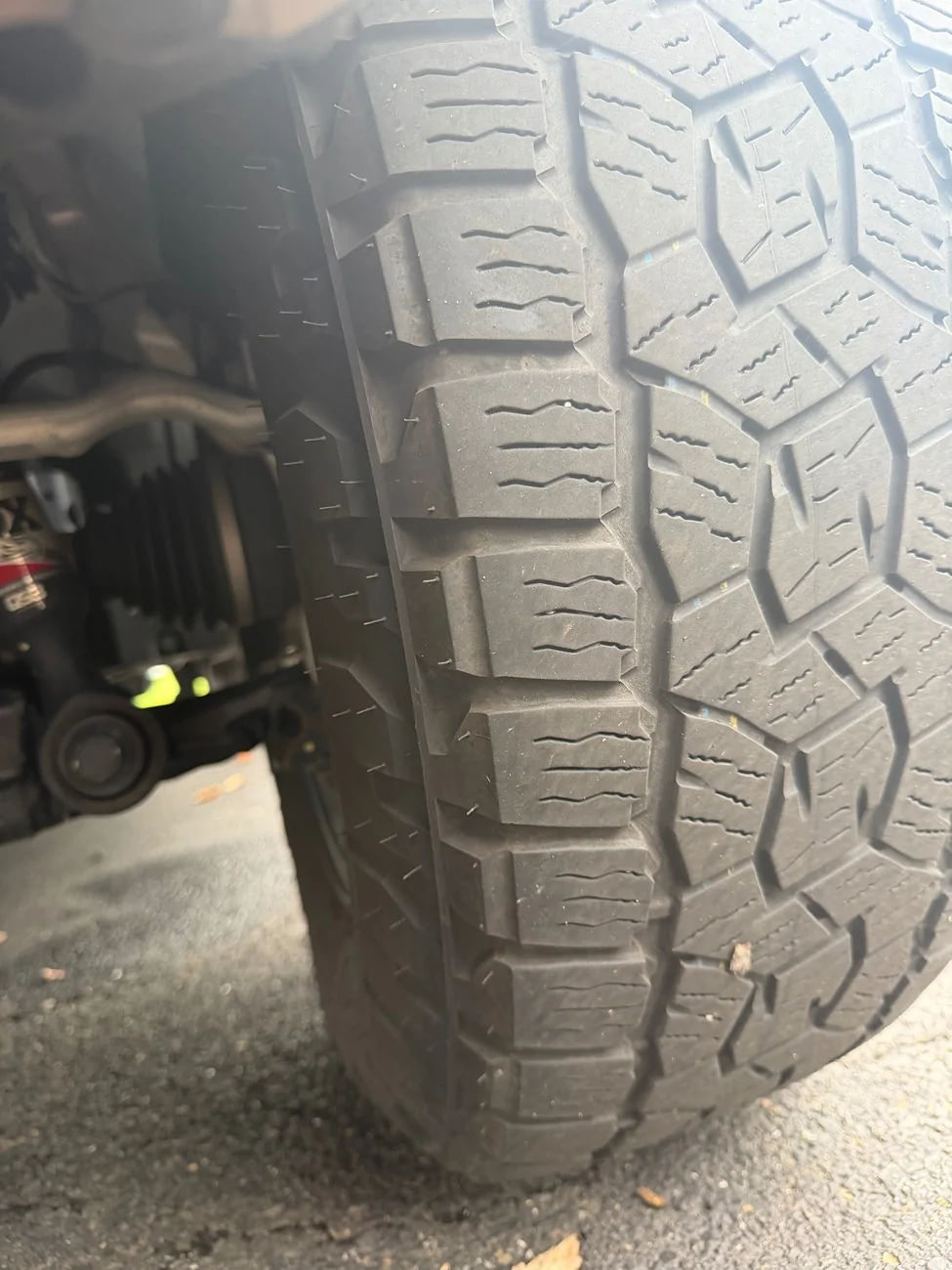
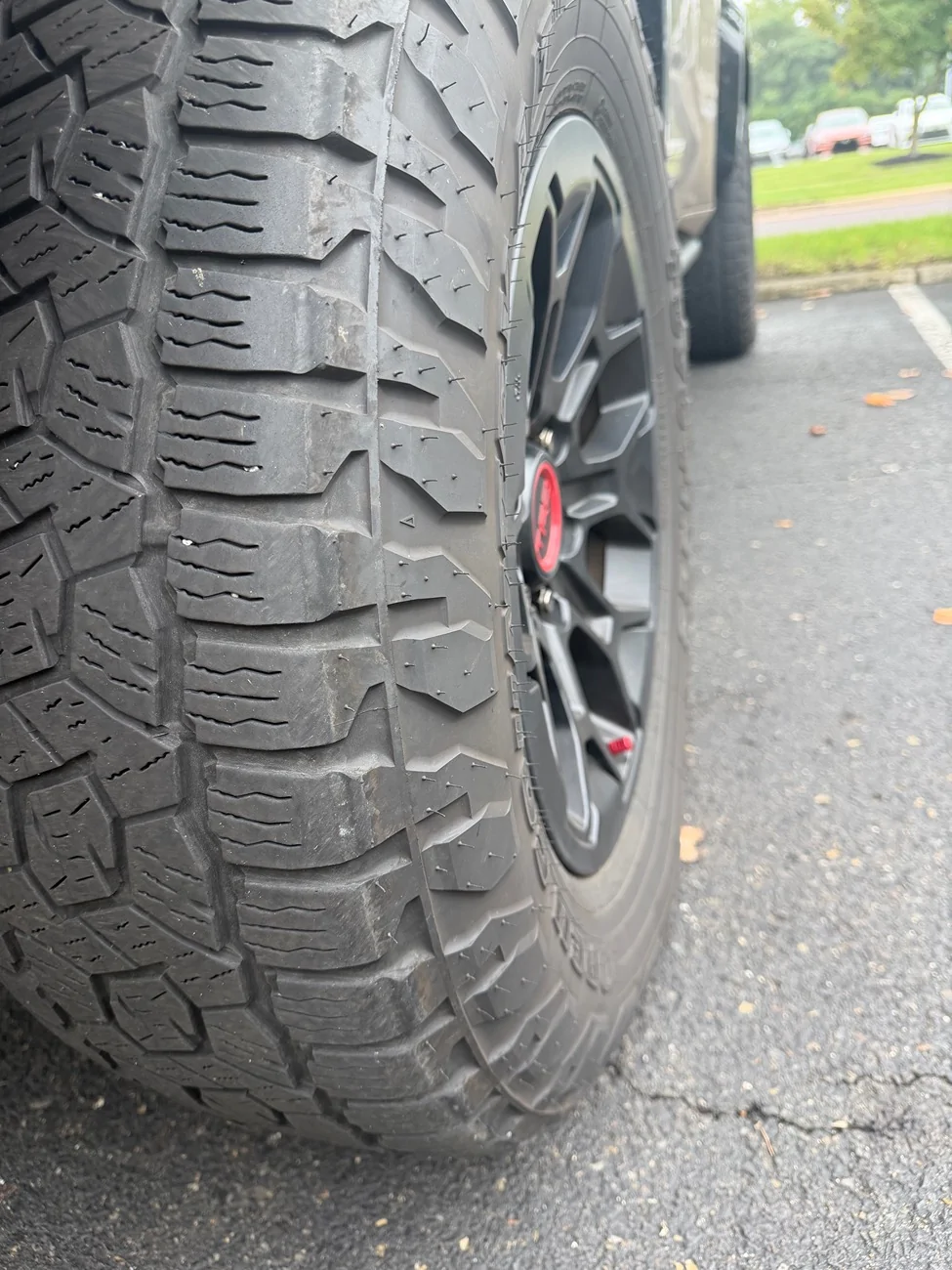
So my issue is it’s just the outside outer edge of the tread that it’s happening to on all 4 tires. The tread on the inside edge closest to frame of truck appear is not wearing as much.


Any ideas?
Sponsored


pmedicj

TRD Pro
Well-known member
Joined
Feb 18, 2026
Threads
1
Messages
126
Reaction score
75
Location
MA
Vehicle(s)
4Runner
Buy new tires, have an alignment done, chalk test the tires and inflate accordingly. You’re on oem tires with 13k+ and they are good for about 20-30k max.
Post a picture of these tires.
 
OP
OP

Strife21

TRD Pro
Member
First Name
Greg
Joined
Sep 16, 2025
Threads
3
Messages
16
Reaction score
13
Location
PA
Vehicle(s)
2025 4runner TRD PRO
Buy new tires, have an alignment done, chalk test the tires and inflate accordingly. You’re on oem tires with 13k+ and they are good for about 20-30k max.
Post a picture of these tires.
When I get new tires and alignment should I have them try to get closer to 0 camber then my alignment results above?

2025 2026 4runner 6th gen Question on tire wear 2025 TRD PRO IMG_5496


2025 2026 4runner 6th gen Question on tire wear 2025 TRD PRO IMG_5495
 

pmedicj

TRD Pro
Well-known member
Joined
Feb 18, 2026
Threads
1
Messages
126
Reaction score
75
Location
MA
Vehicle(s)
4Runner
When I get new tires and alignment should I have them try to get closer to 0 camber then my alignment results above?

IMG_5496.webp


IMG_5495.webp
Aggressive lug tires are sensitive to inflation, alignment and hard cornering and need to be rotated. If the alignment is good and it drives straight, I’d leave it alone and keep up on the pressure and rotations.
what are your shock settings at? I have mine set on #2, I noticed excessive roll and dive on setting #1 and that will also cause wear on these tread lugs. It looks like it’s pushing when cornering but for 13k+ miles you’re doing good in my book. If they take out all the toe and camber it will steer and drive like shit. It’s a fine balance with off road tires. 🤷🏻‍♂️
 
OP
OP

Strife21

TRD Pro
Member
First Name
Greg
Joined
Sep 16, 2025
Threads
3
Messages
16
Reaction score
13
Location
PA
Vehicle(s)
2025 4runner TRD PRO
So I recently switched to setting two as I couldn’t stand the body roll
 

Dr_Al

Well-known member
First Name
Alex
Joined
Jun 19, 2025
Threads
2
Messages
115
Reaction score
64
Location
USA
Vehicle(s)
Rav4, Tundra
If they continue to wear like that it might be worth having a tire shop rotate the tires and put the worn edges on the inside of the wheel. They would have to dismount, flip, mount, and then balance them. But for the price of tires it might make sense. It could just be your driving habit.
 

josiahg52

Trailhunter
Well-known member
First Name
Josiah
Joined
Jun 6, 2026
Threads
1
Messages
200
Reaction score
100
Location
Maine, United States
Vehicle(s)
2026 Trailhunter, 2018 Ram 2500, 2001 BMW M5, 2001 BMW X5 35d
When I get new tires and alignment should I have them try to get closer to 0 camber then my alignment results above?

IMG_5496.webp


IMG_5495.webp
First, no, I would not consider this wear normal simply because it's a four-wheel-drive/off-road-oriented vehicle. Your aggressive rotation schedule may actually be masking where the wear is originating. Based on the alignment sheet, I'd have the rear measurements verified first. The +0.01° LR versus −0.16° RR toe is a significant side-to-side difference on a solid rear axle. If that measurement is repeatable, I'd want to determine why it's there and whether something needs correcting.

Second, that alignment result isn't confidence inspiring and I'm not surprised abnormal tire wear is occurring in one or more positions.

Up front, +0.07° toe per side/+0.14° total is more than I would want. I'd personally target approximately +0.02° per side and no more than +0.04° total. I'd also prefer the caster more closely matched side-to-side. I'd also have the positive front camber brought closer to neutral/slightly negative and reasonably equal side-to-side, if the available adjustment permits it, while prioritizing minimum toe, straight tracking and a properly centered steering wheel. The rear −0.3°/−0.2° camber doesn't concern me; it's essentially symmetrical and isn't normally adjustable anyway.

Afterward, I'd extend the rotation interval enough to watch the individual positions. At 13,000 miles with rotations every 3–4K, however, the existing tires may already have enough redistributed wear that they won't give you a completely clean diagnostic picture going forward.
 
OP
OP

Strife21

TRD Pro
Member
First Name
Greg
Joined
Sep 16, 2025
Threads
3
Messages
16
Reaction score
13
Location
PA
Vehicle(s)
2025 4runner TRD PRO
First, no, I would not consider this wear normal simply because it's a four-wheel-drive/off-road-oriented vehicle. Your aggressive rotation schedule may actually be masking where the wear is originating. Based on the alignment sheet, I'd have the rear measurements verified first. The +0.01° LR versus −0.16° RR toe is a significant side-to-side difference on a solid rear axle. If that measurement is repeatable, I'd want to determine why it's there and whether something needs correcting.

Second, that alignment result isn't confidence inspiring and I'm not surprised abnormal tire wear is occurring in one or more positions.

Up front, +0.07° toe per side/+0.14° total is more than I would want. I'd personally target approximately +0.02° per side and no more than +0.04° total. I'd also prefer the caster more closely matched side-to-side. I'd also have the positive front camber brought closer to neutral/slightly negative and reasonably equal side-to-side, if the available adjustment permits it, while prioritizing minimum toe, straight tracking and a properly centered steering wheel. The rear −0.3°/−0.2° camber doesn't concern me; it's essentially symmetrical and isn't normally adjustable anyway.

Afterward, I'd extend the rotation interval enough to watch the individual positions. At 13,000 miles with rotations every 3–4K, however, the existing tires may already have enough redistributed wear that they won't give you a completely clean diagnostic picture going forward.
Sounds good whenever I ask about the back the dealerships tell me it’s not adjustable. Not sure what to do there

Measurements on rear were verified 4 times.

At dealerships and independent shops.
Sponsored


Top