Sponsored

CAMTuning

TRD Off-Road
Well-known member
Site Sponsor
First Name
Cam
Joined
Nov 14, 2025
Threads
9
Messages
101
Reaction score
148
Location
NM
Vehicle(s)
2025 Tacoma TRD OffRoad
Had the opportunity to get a 2026 4Runner TRD Sport on our dyno.


Truck is bone stock, ~3,000 miles, running 86 octane.


For context, I have extensive remote tuning experience with this platform, and have many Tacomas on our dyno, both gas and hybrid.
This was a great opportunity to have a local one on the dyno and validate what we’ve consistently been seeing in logs.

Baseline

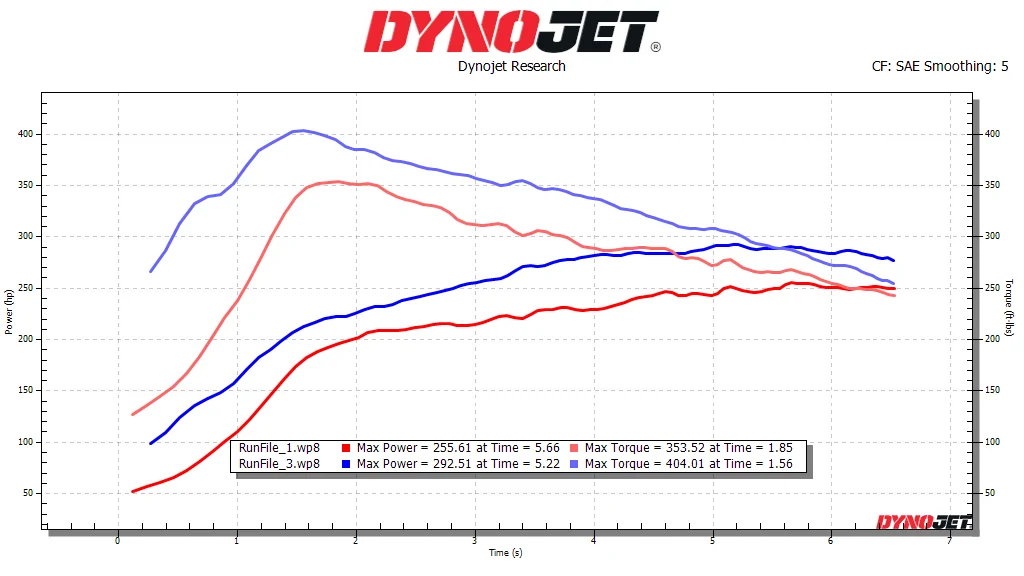
  • 255whp / 353wtq
  • KCLV: 13
  • Lean behavior through peak torque
  • Roughly ~15whp lower than most Tacomas we’ve tested

So not just low octane — also a softer baseline than expected for this platform.

After Tuning (Still 86 Octane)

  • 292whp / 404wtq
  • KCLV increased to 17
  • Fueling corrected — especially in the peak torque region, now safer than stock under load
Gains

  • +37whp
  • +50wtq
Observations
  • The lean condition in the torque region matches what we’ve seen on the dyno and remote tuning.
  • Same engine/platform — Baseline and gains are in line with 91, but lower peak numbers due to octane limitation.
Bigger Picture

Having tuned a large number of these remotely, the patterns were already there in the data.


The dyno just confirmed it:

  • Stock calibration isn’t always ideal under load
  • Even on 86 octane, you can improve power and safety at the same time

Not trying to turn this into a stock vs tuned debate — just sharing what shows up when you actually measure it.

Bottom Line

  • Same 2.4T platform (Tacoma / 4Runner)
  • Same trends in logs and on the dyno
  • And even on 86, there’s meaningful room for improvement when it’s calibrated properly
2025 4runner 6th gen 2026 4Runner TRD Sport Dyno Results (Stock vs Tuned on 86 Octane) Mike 86 octan
Sponsored

 
OP
OP
CAMTuning

CAMTuning

TRD Off-Road
Well-known member
Site Sponsor
First Name
Cam
Joined
Nov 14, 2025
Threads
9
Messages
101
Reaction score
148
Location
NM
Vehicle(s)
2025 Tacoma TRD OffRoad
Wish you would have done a run on premium before tune to have another dataset of the difference octane makes in these engines.
It showed up with a full tank of 86, so no opportunity to do that.
I've had a number of Tacomas on the dyno on 91 and have a stable baseline what what they make with both factory size and oversized tires. I typically see 267-270whp on 91 on stock tires with the stock tune.

He's going to switch to 91, and when he does, I'll gather some dyno data on the stock tune. With the Accessport it only takes a couple of minutes to load the stock mapping back and do some runs.
 
OP
OP
CAMTuning

CAMTuning

TRD Off-Road
Well-known member
Site Sponsor
First Name
Cam
Joined
Nov 14, 2025
Threads
9
Messages
101
Reaction score
148
Location
NM
Vehicle(s)
2025 Tacoma TRD OffRoad
What tune are you using and where to purchase it at?
This is a custom calibration done by me using the COBB Accessport. I’ve been a COBB Protuner for about 15 years and have over 20 years of experience working with forced-induction 4-cylinder platforms.

You can find more info and purchase options here: https://camtuningperformance.com/

If you have any questions or want to go over your setup, feel free to reach out. Most of the tuning I’m doing on this platform is handled 100% remotely.
 

Suprman_82

TRD Sport
New member
First Name
Billy
Joined
Mar 7, 2026
Threads
1
Messages
4
Reaction score
1
Location
Arizona
Vehicle(s)
2025 toyota 4runner
Awesome thanks!! And the only option for my 2025 trd sport would be the $900 one correct?
 
OP
OP
CAMTuning

CAMTuning

TRD Off-Road
Well-known member
Site Sponsor
First Name
Cam
Joined
Nov 14, 2025
Threads
9
Messages
101
Reaction score
148
Location
NM
Vehicle(s)
2025 Tacoma TRD OffRoad
Awesome thanks!! And the only option for my 2025 trd sport would be the $900 one correct?
Reflash Tune + Accessport ($969):
This is a pre-built calibration that I’ve developed and refined across a lot of these trucks. It’s a big improvement over stock in throttle response, power delivery, and overall drivability.
  • No revisions required
  • Quick turnaround
  • Great option for mostly stock vehicles or with common intake modifications.
  • We still review data from your vehicle after flashing to make sure everything is operating exactly as it should. If I see something that needs changed, I will change it at no charge.

Custom Tune + Accessport ($1,169):
This is a fully personalized calibration built specifically for your truck. We go through a revision process (typically 3–5 revisions) where you send logs, I make adjustments, and we dial everything in based on your fuel, environment, and how you want the vehicle to drive.
  • Tailored to your exact setup
  • Can be more/less aggressive depending on your preference
  • Ideal if you want everything as dialed as possible or plan to modify
Right now, COBB is running a 10% off sale through the 30th, and that discount applies to the full bundle:
  • Reflash bundle: $969 → $873
  • Custom bundle: $1,169 → $1,052
 

John2112

Trailhunter
Well-known member
First Name
John
Joined
May 5, 2025
Threads
0
Messages
139
Reaction score
120
Location
Austin Texas
Vehicle(s)
2025 Toyota 4Runner Trail Hunter & 2006 Toyota Matrix
Wish you would have done a run on premium before tune to have another dataset of the difference octane makes in these engines.
Octane makes almost no difference, I've done similar tests. That's always been a myth that you get better performance with higher octane. That only makes a difference if you have a high performance engine that requires it.
 

spyder40

TRD Off-Road Premium
Well-known member
Joined
Apr 7, 2025
Threads
0
Messages
165
Reaction score
95
Location
Indiana
Vehicle(s)
2021 4Runner ORP
Reflash Tune + Accessport ($969):
This is a pre-built calibration that I’ve developed and refined across a lot of these trucks. It’s a big improvement over stock in throttle response, power delivery, and overall drivability.
  • No revisions required
  • Quick turnaround
  • Great option for mostly stock vehicles or with common intake modifications.
  • We still review data from your vehicle after flashing to make sure everything is operating exactly as it should. If I see something that needs changed, I will change it at no charge.

Custom Tune + Accessport ($1,169):
This is a fully personalized calibration built specifically for your truck. We go through a revision process (typically 3–5 revisions) where you send logs, I make adjustments, and we dial everything in based on your fuel, environment, and how you want the vehicle to drive.
  • Tailored to your exact setup
  • Can be more/less aggressive depending on your preference
  • Ideal if you want everything as dialed as possible or plan to modify
Right now, COBB is running a 10% off sale through the 30th, and that discount applies to the full bundle:
  • Reflash bundle: $969 → $873
  • Custom bundle: $1,169 → $1,052
How long is the sale going on? In the middle of taxes and owe unfortunately
 
OP
OP
CAMTuning

CAMTuning

TRD Off-Road
Well-known member
Site Sponsor
First Name
Cam
Joined
Nov 14, 2025
Threads
9
Messages
101
Reaction score
148
Location
NM
Vehicle(s)
2025 Tacoma TRD OffRoad
How long is the sale going on? In the middle of taxes and owe unfortunately
Through 3/30. I know the pain! A nicer driving 4Runner will help you cope with the sting of sending all your money to the IRS though :LOL:
 

HVLA

TRD Off-Road Premium
Well-known member
Joined
Feb 28, 2025
Threads
9
Messages
513
Reaction score
354
Location
USA
Vehicle(s)
Lexus
Octane makes almost no difference, I've done similar tests. That's always been a myth that you get better performance with higher octane. That only makes a difference if you have a high performance engine that requires it.
100% wrong when it comes to this engine. Camtuning even just confirmed it with their tacoma dynos. So did Stillen. It is right around 15-20hp increase.
 
OP
OP
CAMTuning

CAMTuning

TRD Off-Road
Well-known member
Site Sponsor
First Name
Cam
Joined
Nov 14, 2025
Threads
9
Messages
101
Reaction score
148
Location
NM
Vehicle(s)
2025 Tacoma TRD OffRoad
Octane makes almost no difference, I've done similar tests. That's always been a myth that you get better performance with higher octane. That only makes a difference if you have a high performance engine that requires it.
On an 11:1 Compression engine with a turbo, it absolutely matters. I have a deep understanding on how the ecu works on this platform, and while it "can" safely run lower octane, there are a number of reasons I wouldn't.

Lower octane = lower knock resistance.
When knock starts, the ECU pulls ignition timing to protect the engine.

When timing is pulled:
  • Combustion happens later
  • Less power is made
  • More heat goes out the exhaust
That directly means:
  • Higher EGTs
  • More heat through the exhaust valves and turbo
  • Less efficient combustion overall
 

John2112

Trailhunter
Well-known member
First Name
John
Joined
May 5, 2025
Threads
0
Messages
139
Reaction score
120
Location
Austin Texas
Vehicle(s)
2025 Toyota 4Runner Trail Hunter & 2006 Toyota Matrix
100% wrong when it comes to this engine. Camtuning even just confirmed it with their tacoma dynos. So did Stillen. It is right around 15-20hp increase.
The tuning yes, but octane does not make a difference. 15 to 20 horsepower is barely perceived.

1. Octane Measures Stability, Not Energy
Most people assume high octane fuel has more "energy" or "explosive power" than regular fuel. It doesn’t.
In fact, regular and premium fuel contain roughly the same amount of chemical energy. The octane rating actually measures the fuel's resistance to detonation (also known as engine knock).
Low Octane: Ignites more easily under pressure.
High Octane: Harder to ignite; designed to withstand higher compression without firing prematurely.
2. The "Pre-Ignition" Problem
In a high-performance engine, the pistons compress the air-fuel mixture much more tightly to extract more power. If you put regular gas in a high-performance engine, the heat and pressure might cause the gas to explode before the spark plug even fires. This is called "knocking," and it can destroy an engine.
In a regular commuter car, the compression is much lower. Regular gas works perfectly because the engine never reaches the pressures that would require the stability of premium fuel.
3. Why It Won't Improve Your MPG
If your car is designed for 87 octane, its computer (ECU) is tuned for that specific combustion timing.
Using 91 or 93 octane doesn't change how the engine breathes or how much fuel it injects.
Because the energy density is the same, your car will travel the exact same distance on a gallon of premium as it would on a gallon of regular.
The Result: You are essentially paying 20–50 cents more per gallon for a capability your engine isn't even using.
 
OP
OP
CAMTuning

CAMTuning

TRD Off-Road
Well-known member
Site Sponsor
First Name
Cam
Joined
Nov 14, 2025
Threads
9
Messages
101
Reaction score
148
Location
NM
Vehicle(s)
2025 Tacoma TRD OffRoad
The tuning yes, but octane does not make a difference. 15 to 20 horsepower is barely perceived.

1. Octane Measures Stability, Not Energy
Most people assume high octane fuel has more "energy" or "explosive power" than regular fuel. It doesn’t.
In fact, regular and premium fuel contain roughly the same amount of chemical energy. The octane rating actually measures the fuel's resistance to detonation (also known as engine knock).
Low Octane: Ignites more easily under pressure.
High Octane: Harder to ignite; designed to withstand higher compression without firing prematurely.
2. The "Pre-Ignition" Problem
In a high-performance engine, the pistons compress the air-fuel mixture much more tightly to extract more power. If you put regular gas in a high-performance engine, the heat and pressure might cause the gas to explode before the spark plug even fires. This is called "knocking," and it can destroy an engine.
In a regular commuter car, the compression is much lower. Regular gas works perfectly because the engine never reaches the pressures that would require the stability of premium fuel.
3. Why It Won't Improve Your MPG
If your car is designed for 87 octane, its computer (ECU) is tuned for that specific combustion timing.
Using 91 or 93 octane doesn't change how the engine breathes or how much fuel it injects.
Because the energy density is the same, your car will travel the exact same distance on a gallon of premium as it would on a gallon of regular.
The Result: You are essentially paying 20–50 cents more per gallon for a capability your engine isn't even using.
You said it yourself (or maybe AI did):
In a high-performance engine, the pistons compress the air-fuel mixture much more tightly to extract more power.
11:1 and boosted is VERY high cylinder pressure.
Sponsored


Top